Cribbage rules
Cribbage is a card game for two players. You score for card combinations: cards that add up to 15, pairs, runs and flushes. Points are marked with pegs on a board, and the first player to 121 wins. The dealer also scores the crib, an extra hand built from both players’ discards.
Also called Crib, Six-card cribbage.
- Players
- 2. Also played by 3, or by 4 in 2 teams
- You need
- A standard 52-card deck, and a cribbage board with pegs or a pencil and paper
- Deal
- 6 cards each. Each player then puts 2 cards face down into the crib, an extra hand that scores for the dealer.
- Goal
- Score points for card combinations, first as you play your cards and again when you count your hand
- Game ends
- The first player to 121 points wins
- Playing time
- About 30 minutes
Quick start
- Each player cuts the deck. The player with the lower card deals 6 cards each. Both players then put 2 cards face down into the crib, an extra hand for the dealer.
- The non-dealer cuts the remaining cards. The dealer turns the top card of the lower part face up. This is the starter. If it is a jack, the dealer scores 2.
- Starting with the non-dealer, take turns playing one card face up and saying the running total. Face cards count 10 and aces count 1. The total can never pass 31.
- Score as you play: 2 for making the total 15 or 31, 2 for pairing the card before, and 1 for each card in a run of 3 or more.
- If you cannot play without passing 31, say “go.” The other player plays on if able. Whoever played last scores 1, unless that card made 31. The count restarts at zero.
- When all cards are played, count the non-dealer’s hand, then the dealer’s hand, then the crib. The starter counts as a fifth card in each. The first player to 121 points wins.
Rule sheet and score sheet
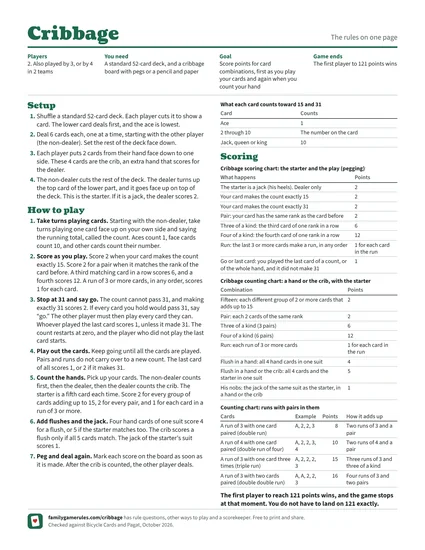
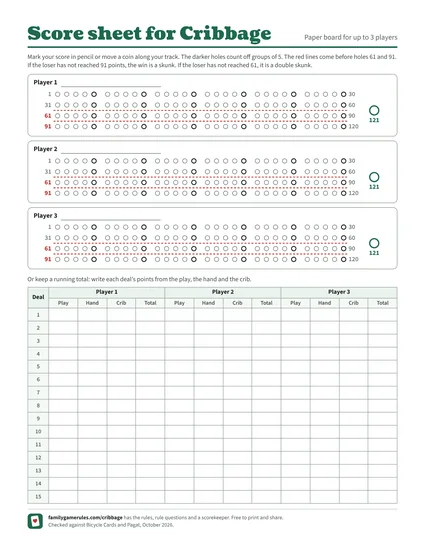
Print the whole game on one page, and a score sheet made for Cribbage. Both are free PDFs for Letter paper.
Setup
2 players. Versions for 3 players and for 4 players in 2 teams are further down.
You need: A standard 52-card deck with the jokers taken out.
| In the set | Count |
|---|---|
| Aces | 4 |
| Number cards, 2 through 10 | 36 |
| Jacks, queens and kings | 12 |
| Total | 52 |
- When you add cards up, an ace counts 1 and a jack, queen or king counts 10. Every other card counts the number on it.
- In runs and when you cut the deck, the king is the highest card and the ace is always the lowest.
- You also need a cribbage board with 2 pegs for each player. A pencil and paper work if you have no board.
- Shuffle a standard 52-card deck. Each player cuts it to show a card. The lower card deals first, and the ace is lowest.
- Deal 6 cards each, one at a time, starting with the other player (the non-dealer). Set the rest of the deck face down.
- Each player puts 2 cards from their hand face down to one side. These 4 cards are the crib, an extra hand that scores for the dealer.
- The non-dealer cuts the rest of the deck. The dealer turns up the top card of the lower part, and it goes face up on top of the deck. This is the starter. If it is a jack, the dealer scores 2.
| Players | Each player gets | Notes |
|---|---|---|
| 2 | 6 cards | Each player puts 2 cards in the crib and keeps 4. |
| 3 | 5 cards | 1 more card is dealt face down to the crib. Each player adds 1 card and keeps 4. |
| 4 | 5 cards | Each player puts 1 card in the crib and keeps 4. |
Each player’s hand
The crib
Belongs to the dealer
The deck
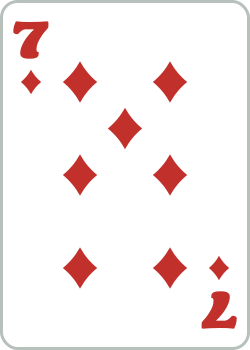
The starter is face up on top
- If both players cut cards of the same rank, cut again. Some players also cut again when both cards count 10, such as a jack and a king.
- The dealer shuffles and the non-dealer cuts the deck before each deal.
- You choose your 2 crib cards before the starter is turned. Nobody looks at the crib until the hands have been counted.
- Put the board where both players can reach it. Each player takes 2 pegs of one color.
How to play
A hand has two parts. In the play, you take turns playing your cards and score as you go. This part is also called pegging. In the show, you count the points in each hand and in the crib.
-
Take turns playing cards
Starting with the non-dealer, take turns playing one card face up on your own side and saying the running total, called the count. Aces count 1, face cards count 10, and other cards count their number.
- The first player says the value of the card. After that, each player says the count with their card added. If a 4 is followed by a king, the second player says 14.
- Keep your played cards in front of you and apart from the other player’s cards. You pick them up again to count your hand.
- The starter takes no part in the play. It comes back in when the hands are counted.
-
Score as you play
Score 2 when your card makes the count exactly 15. Score 2 for a pair when it matches the rank of the card before. A third matching card in a row scores 6, and a fourth scores 12. A run of 3 or more cards, in any order, scores 1 for each card.
- A pair needs two cards of the same rank. A king and a queen both count 10, but they are not a pair.
- A run is 3 or more cards whose ranks follow one another, such as 4, 5, 6. They can be played in any order. If the last three cards played are a 4, a 6 and a 5, whoever played the 5 scores 3 for the run.
- A run can keep growing. After 4, 6, 5, the next player scores 4 by adding a 3 or a 7.
- No other card may sit inside a run. After 6, 7, 7, an 8 does not score a run, because the second 7 is in the way.
- In runs the ace is always low. Ace, 2, 3 is a run. Queen, king, ace is not.
- One card can score in two ways at once. A 5 played on a 4 and a 6 makes 15 and a run of three, for 5 points.
- Pairs and runs are made from the cards in the order they were played, whoever played them. When you play twice in a row after a go, you can pair your own card.
- Suits do not matter in the play. Flushes score only when the hands are counted.
-
Stop at 31 and say go
The count cannot pass 31, and making exactly 31 scores 2. If every card you hold would pass 31, say “go.” The other player must then play every card they can. Whoever played the last card scores 1, unless it made 31. The count restarts at zero, and the player who did not play the last card starts.
- You may say “go” only when none of your cards can be played. If you hold a card that keeps the count at 31 or under, you must play it.
- After a go, the player who said “go” starts the new count. After a 31, the player who did not make the 31 starts.
- Making exactly 31 scores 2 points in total. You do not get 1 more for the go.
- Sometimes the other player cannot play after your go either. They still score 1, because they played the last card.
-
Play out the cards
Keep going until all the cards are played. Pairs and runs do not carry over to a new count. The last card of all scores 1, or 2 if it makes 31.
- If you run out of cards first, the other player plays their remaining cards one after another and scores for anything they make.
- If the other player is out of cards and your next card would pass 31, that count is over. Whoever played its last card scores 1 for the go, and you start a new count.
-
Count the hands
Pick up your cards. The non-dealer counts first, then the dealer, then the dealer counts the crib. The starter is a fifth card each time. Score 2 for every group of cards adding up to 15, 2 for every pair, and 1 for each card in a run of 3 or more.
- Count out loud so the other player can check. A good order is the 15s first, then the pairs, then the runs.
- The same card can be used in more than one combination. Each 15, pair or run must differ from the others by at least one card.
- Three of a kind holds 3 different pairs, so it scores 6. Four of a kind holds 6 pairs and scores 12.
- Count a run at its full length. Four cards in a row score 4. They do not also count as two runs of 3.
- When a run has a pair in it, count the run once with each card of the pair. The cards 6, 7, 7, 8 hold two runs of three.
- The crib is counted the same way as a hand, except for flushes.
-
Add flushes and the jack
Four hand cards of one suit score 4 for a flush, or 5 if the starter matches too. The crib scores a flush only if all 5 cards match. The jack of the starter’s suit scores 1.
- Three cards of one suit in your hand plus the starter are not a flush.
- The point for the jack is called his nobs. It counts when the jack is one of the 4 cards in a hand or in the crib.
Your hand
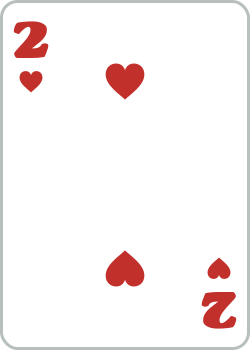
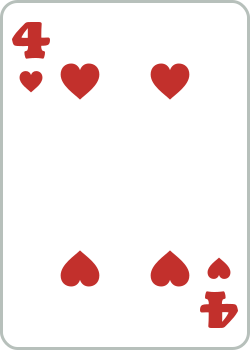
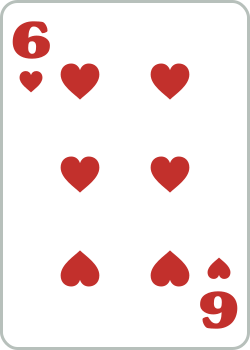
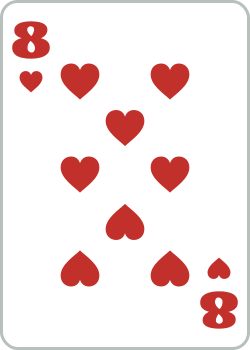
All hearts: 4 points
Starter
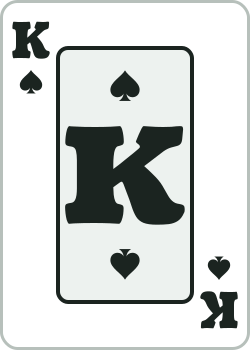
A heart here would make it 5
A flush in a hand scores 4 even when the starter is another suit. The same 4 cards in the crib would score nothing. -
Peg and deal again
Mark each score on the board as soon as it is made. After the crib is counted, the other player deals.
| Card | Counts |
|---|---|
| Ace | 1 |
| 2 through 10 | The number on the card |
| Jack, queen or king | 10 |
Example: a go, a 31 and a new count
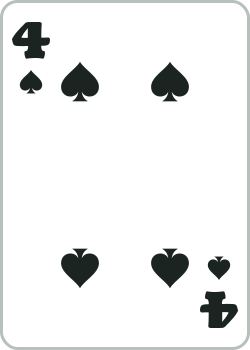
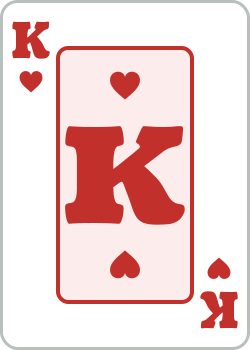
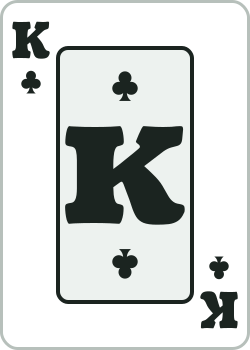
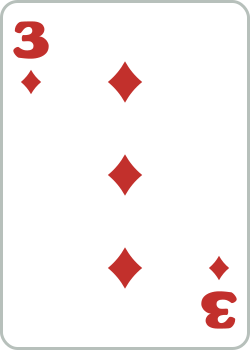
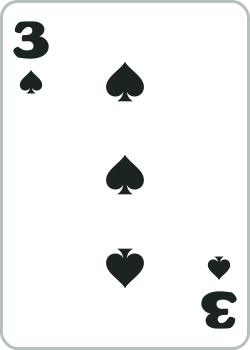
You are the non-dealer, so you play first. You play the 4 of spades and say 4. The dealer plays the 6 of hearts and says 10. You play the 5 of diamonds and say 15. That scores 2 for the 15 and 3 for a run, because 4, 6 and 5 make a run of three even though they came out of order. The dealer plays the king of clubs for 25. Your 9 and your king would both pass 31, so you say “go.” The dealer has to keep going and plays the 3 of diamonds for 28, then the 3 of spades for 31. That scores 2 for the pair and 2 for the 31. The count goes back to zero. You did not play the last card, so you start the new count with your king for 10 and then your 9 for 19. The dealer is out of cards, so your 9 is the last card of the hand and scores 1. You scored 6 points in the play and the dealer scored 4.
Your hand before the play
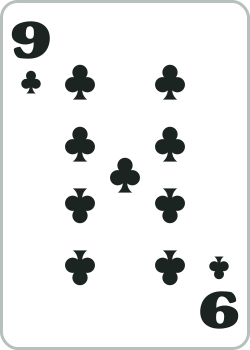
The dealer’s hand before the play
First count, in the order played
The count: 4, 10, 15, 25, 28, 31
Second count
The count: 10, 19
Scoring
Points are scored at three moments in a hand: when the starter is turned, during the play, and when the hands and the crib are counted. The first two charts below list every way to score.
| What happens | Points |
|---|---|
| The starter is a jack (his heels). Dealer only | 2 |
| Your card makes the count exactly 15 | 2 |
| Your card makes the count exactly 31 | 2 |
| Pair: your card has the same rank as the card before | 2 |
| Three of a kind: the third card of one rank in a row | 6 |
| Four of a kind: the fourth card of one rank in a row | 12 |
| Run: the last 3 or more cards make a run, in any order | 1 for each card in the run |
| Go or last card: you played the last card of a count, or of the whole hand, and it did not make 31 | 1 |
| Combination | Points |
|---|---|
| Fifteen: each different group of 2 or more cards that adds up to 15 | 2 |
| Pair: each 2 cards of the same rank | 2 |
| Three of a kind (3 pairs) | 6 |
| Four of a kind (6 pairs) | 12 |
| Run: each run of 3 or more cards | 1 for each card in the run |
| Flush in a hand: all 4 hand cards in one suit | 4 |
| Flush in a hand or the crib: all 4 cards and the starter in one suit | 5 |
| His nobs: the jack of the same suit as the starter, in a hand or the crib | 1 |
| Cards | Example | Points | How it adds up |
|---|---|---|---|
| A run of 3 with one card paired (double run) | A, 2, 2, 3 | 8 | Two runs of 3 and a pair |
| A run of 4 with one card paired (double run of four) | A, 2, 2, 3, 4 | 10 | Two runs of 4 and a pair |
| A run of 3 with one card three times (triple run) | A, 2, 2, 2, 3 | 15 | Three runs of 3 and three of a kind |
| A run of 3 with two cards paired (double double run) | A, A, 2, 2, 3 | 16 | Four runs of 3 and two pairs |
- In the play, a card that makes 31 scores 2 in total. It does not also score 1 for the go or for last card.
- A hand is always counted as 5 cards: its own 4 and the starter. The crib is counted the same way.
- A card can be used in more than one combination. Each combination must differ from the others by at least one card.
- Runs go by rank, and suits do not matter. The ace is low, so queen, king, ace is not a run.
- Count every run at its full length. Four cards in a row score 4 and do not also count as two runs of 3. When a run holds a pair, count the run once with each card of the pair.
- A flush scores 4 or 5, never both. Three hand cards of one suit plus the starter are not a flush. In the crib, only the 5-card flush scores.
- His nobs is only for a jack among the 4 cards of a hand or the crib. A jack turned up as the starter is not his nobs.
- The totals in the third chart leave out 15s. If the same cards also make 15s, add those on top.
- The highest possible hand is 29: three 5s and a jack in your hand, with the fourth 5 as the starter in the same suit as your jack.
- No hand can score 19, 25, 26 or 27.
The first player to reach 121 points wins, and the game stops at that moment. You do not have to land on 121 exactly.
A cribbage board has a track of holes for each player, and each player has 2 pegs. For your first score, move one peg that many holes. For every score after that, jump your back peg ahead of your front peg by the points you made. The front peg shows your total, and the gap between the pegs shows your last score. A classic board gives each player 2 rows of 30 holes. Go away from the game hole along the outer row and come back along the inner row. Do that twice, then step into the game hole for 121. Other boards give each player one long track of 120 holes that ends in a game hole. With no board, print the paper board from this site or keep a running total with pencil and paper.
A worked example: counting one hand
Your hand is the 4 of diamonds, the 5 of clubs, the 5 of hearts and the jack of spades. The starter is the 6 of spades, so you count 5 cards. Go through the 15s first, then the pairs, then the runs, then the flush and the jack. This hand has no flush, because your 4 cards are not all one suit. It scores 17.
Your hand
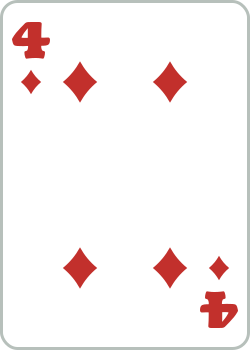
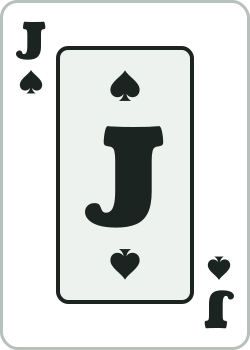
Starter
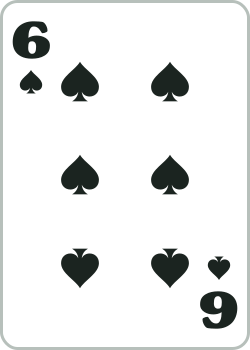
Same suit as your jack
| What happened | Points |
|---|---|
| Fifteen: 5♣ and J♠ (5 + 10) | 2 |
| Fifteen: 5♥ and J♠ (5 + 10) | 2 |
| Fifteen: 4♦, 5♣ and 6♠ (4 + 5 + 6) | 2 |
| Fifteen: 4♦, 5♥ and 6♠ (4 + 5 + 6) | 2 |
| Pair: 5♣ and 5♥ | 2 |
| Run of three: 4♦, 5♣, 6♠ | 3 |
| Run of three: 4♦, 5♥, 6♠ | 3 |
| His nobs: J♠ is the same suit as the starter | 1 |
| Your hand | 17 |
Scorekeeper
Two or three players, or two teams, pegging to 121 on a drawn board. Quick buttons add the common pegging scores, and a number entry adds a hand or crib count of up to 29. Marks at 61 and 91 show the double skunk and skunk lines. It works in this browser, keeps the game if the page reloads, and needs no account.
Other ways to play
Cribbage for 3 players
Deal 5 cards to each player and 1 card face down to the crib. Each player then puts 1 card in the crib, so each hand and the crib have 4 cards. The crib belongs to the dealer. The player on the dealer’s left cuts for the starter and plays first, and play goes clockwise. When you cannot play, say “go.” The others keep playing in turn until nobody can play. The player who played the last card scores 1, or 2 for making 31, and the player on their left starts the next count. Count the hands starting on the dealer’s left. The dealer counts last and then counts the crib. Everyone scores for themselves, and the first to 121 wins. The deal passes to the left. Use a board with 3 tracks, or pencil and paper.
Cribbage for 4 players (partners)
Play in 2 teams of 2, with partners sitting across from each other. Deal 5 cards each. Each player puts 1 card in the crib, which belongs to the dealer. The player on the dealer’s left cuts for the starter and plays first, and play goes clockwise. The go works as it does with 3 players: when you cannot play, the others carry on, and whoever played the last card scores 1, or 2 for a 31. Count the hands starting on the dealer’s left. The dealer counts last and then counts the crib. Each team pegs on one track, and one partner moves the pegs. Partners may help each other count, but may not say what they hold or which card to play. The first team to 121 wins, and the deal passes to the left.
House rules and other versions
- Muggins
- If you count fewer points than your hand or crib is worth, the other player can say “muggins” and score the points you missed. Some groups also use it for points missed during the play. Muggins is optional, so agree on it before the first deal.
- Skunk and double skunk
- When you play a series of games, a big win can count extra. If the loser has not reached 91 points, the win is a skunk and counts as 2 games. If the loser has not reached 61, it is a double skunk. Groups count that as 3 or 4 games.
- Lurch
- Some groups play the lurch. If the loser has not reached 61 points, the loser is lurched and the win counts as 2 games. Some players use lurch as another word for a skunk.
- Game to 61
- For a shorter game, play to 61 points instead of 121.
- Loser deals first
- When you play several games in a row, some groups have the loser of a game deal first in the next one. Another way: whoever did not deal first in game 1 deals first in game 2, and you cut again before a game 3.
- Two cards dealt to the crib
- Deal 5 cards to each player and 2 cards straight into the crib. Each player then adds 1 card to the crib. After that the game is played as usual.
Rule questions
How many cards do you get in cribbage?
6 each with 2 players, dealt from a standard 52-card deck. Each player puts 2 cards in the crib and plays with the other 4. With 3 or 4 players, each player gets 5 cards and puts 1 in the crib. With 3 players, 1 more card is dealt straight to the crib.
Who goes first in cribbage?
The non-dealer. They play the first card and count their hand first. The dealer counts second and then counts the crib. For the first hand, each player cuts the deck and the lower card deals. After that the players take turns to deal.
What happens after someone says go?
The other player keeps playing cards until they cannot play without passing 31. The player who played the last card then scores 1 point, or 2 if the count is exactly 31. The count goes back to zero, and the player who said go starts the new count. One rule source we checked has the other player start instead, but tournament rules name the player who said go.
Can you say go when you have a card you could play?
No. If you hold a card that keeps the count at 31 or under, you must play it. Tournament rules give the other player 2 points for each card that could have been played.
Do the cards of a run have to be played in order?
No. In the play, a run scores when the last 3 or more cards make a run in any order, with no other card among them. A 4, then a 6, then a 5 scores 3 for the run to whoever played the 5. After 6, 7, 7, an 8 scores nothing for a run, because the second 7 is in the way.
Can the same card count in more than one combination?
Yes. When you count a hand, a card can be part of several 15s, pairs and runs, as long as each combination differs by at least one card. In the play, one card can also score in two ways at once, such as making 15 and a run together.
Does a flush count in the crib?
Only when all 5 cards are the same suit: the 4 crib cards and the starter. That scores 5. In a hand, 4 cards of one suit score 4 without the starter and 5 with it. Flushes never score during the play.
What are his heels and his nobs?
Both are points for a jack. His heels is 2 points for the dealer when the starter turned up is a jack. His nobs is 1 point for the jack of the same suit as the starter, counted with your hand or the crib. Under tournament rules the dealer must mark the 2 points before playing a card, or they are lost.
What is the highest hand in cribbage?
29. You hold three 5s and a jack, and the starter is the fourth 5 in the same suit as your jack. The four 5s score 12 for pairs. Eight different groups of cards add up to 15, for 16 more. The jack scores 1. Hands of 19, 25, 26 and 27 are impossible.
Do you have to reach exactly 121 to win?
No. Any score that takes you to 121 or past it wins, and the game ends at once. That can happen during the play, while counting, or on the dealer’s 2 points for a jack starter. The non-dealer counts first, so the non-dealer can win before the dealer’s hand and the crib are counted.
What is a skunk in cribbage?
A skunk is a win in which the loser has not reached 91 points. In a series of games it counts as 2 games won. A double skunk, with the loser short of 61, counts as 3 or 4 games depending on the group. Agree on skunks before you start.
How does a cribbage board work?
Each player has a track of holes and 2 pegs. To score, jump your back peg ahead of your front peg by the number of points. Your front peg always shows your total. A full game is 121 points. On a classic board with 2 rows of 30 holes for each player, that is twice around plus the game hole.
Words used in Cribbage
- Crib
- The extra hand of 4 cards made from the players’ discards. It scores for the dealer. Also called the box.
- Starter
- The card turned face up after the crib is set aside. It counts as a fifth card in every hand and in the crib. Also called the cut or the turn-up.
- Cut
- To lift off the top part of the deck. Players cut to choose the first dealer and to find the starter.
- Non-dealer
- The player who did not deal. Also called the pone.
- The play
- The first part of a hand, when players take turns playing cards and adding to the count. Also called pegging.
- Pegging
- Marking points by moving pegs on the board. Players also use the word for the play.
- The count
- The running total of the cards played. It starts at zero and cannot pass 31.
- Go
- What you say when you cannot play a card without passing 31. It is also the name of the 1 point for playing the last card.
- The show
- The second part of a hand, when the hands and the crib are counted.
- Fifteen
- Cards that add up to exactly 15. Worth 2 points.
- Run
- Three or more cards in rank order, such as 6, 7, 8. Suits do not matter, and the ace is low.
- Double run
- A run with one card paired, such as 6, 7, 7, 8. It counts as two runs and a pair.
- Pair royal
- An old name for three of a kind, worth 6. Four of a kind is a double pair royal, worth 12.
- Flush
- Cards that are all one suit. A flush scores only in the show.
- His heels
- The 2 points the dealer scores when the starter is a jack.
- His nobs
- The 1 point for the jack of the same suit as the starter. Also called his nob.
- Game hole
- The last hole on the board, reached at 121 points.
- Peg out
- To reach 121 and win the game.
- Street
- One row of 30 holes on a cribbage board.
- Skunk
- A win in which the loser has not reached 91 points.
- Muggins
- An optional rule that lets you claim points the other player failed to count.
- Nineteen hand
- A hand worth no points. The name is a joke, because no hand can score exactly 19.
What you need
- A standard deck of playing cardsAll 52 cards are used. Take out the jokers.Find it on Amazon (A standard deck of playing cards, opens in a new tab)
- A cribbage board with pegsA board for 2 players has 2 tracks, and each player uses 2 pegs.Find it on Amazon (A cribbage board with pegs, opens in a new tab)
- A 3-track cribbage boardOptional. The third track is for a third player.Find it on Amazon (A 3-track cribbage board, opens in a new tab)
- Spare cribbage pegsOptional. Pegs are small and easy to lose.Find it on Amazon (Spare cribbage pegs, opens in a new tab)
As an Amazon Associate, we earn from qualifying purchases. How the site is paid for.
Checked against
These rules are written in our own words from Bicycle Cards and checked against Pagat. Sources last checked on October 11, 2026.
- First source: Bicycle Cards, Cribbage. The deal, the crib, the starter, points in the play and in hands, the 29 hand, the board, the game to 121, and the 61-point, skunk, lurch and muggins variations.
- Second source: Pagat, Six Card Cribbage. The full go procedure and who starts each new count, runs in the play, the flush rules for hands and the crib, pegging with two pegs, winning at 121 or over, and the games for 3 and 4 players.
Other sources we used (3)
- American Cribbage Congress, Cribbage Tournament Rules, 2020 edition. Confirms that the player who says go starts the next count. Also the 2-point penalty for holding back a playable card, the jack point in the crib, the 5-card flush, hole 121 as the game hole, 30-hole streets, the names double run and triple run, and muggins as optional.
- Wikipedia, Rules of cribbage. Details of the 3-player and 4-player games, the duty to play a card when you can, the 29 hand and the hand scores that cannot be made.
- Wikipedia, Cribbage. Board layouts with 60 and 120 holes, streets, keeping score on paper, and the 3 or 4 games counted for a double skunk.
Where the sources differ (12)
| Topic | Bicycle Cards | Pagat | This page |
|---|---|---|---|
| Who starts the new count after a go | Says the opponent of the player who said go starts the next round. That is the same player who scored the point for the go. | The player who did not play the last card starts. After a go, that is the player who said go. | Follows Pagat. The American Cribbage Congress rules and Wikipedia both agree with Pagat. The rule question on the go says that one source differs. |
| Playing on after a go | Says the opponent pegs 1, or 2 for making exactly 31. It does not say the opponent keeps playing cards. | The opponent must carry on playing if possible and scores for anything made. | Follows Pagat. The American Cribbage Congress rules and Wikipedia both agree with Pagat. |
| Five-card flush in a hand | Gives 4 for four hand cards of one suit. Its 5-point line speaks only of the crib with a matching starter. | 4 for four hand cards, or 5 when the start card matches. The crib scores only the 5-card flush. | Follows Pagat, which matches the American Cribbage Congress scoring chart. |
| The jack of the starter’s suit in the crib | Describes the point for the jack in your hand and does not mention the crib. | Describes the point for a hand, and says the crib is scored the same as a hand except for flushes. | The jack scores 1 in a hand or in the crib, as the American Cribbage Congress rules say outright. |
| Points to win | 121, with 61 as a shorter game. | 121. Also reports a 91-point game played around Manchester, England. | 121, with the 61-point game listed as a variant. |
| Skunk and lurch | Lurch: the loser has not reached 61 and the winner scores 2 games. Skunk, as a variation: a loser short of 91 gives a double game, and a loser short of 61 gives a quadruple game. | Both are variations. Lurch: the loser has 60 or fewer and pays a double stake. Skunk: the loser has 61 to 90, double stake. Double skunk: 60 or fewer, triple or quadruple stake. | Variants. A skunk short of 91 counts as 2 games and a double skunk short of 61 counts as 3 or 4. The lurch is listed on its own. Wikipedia’s Cribbage article uses lurch as the British word for a skunk, which the variant notes. |
| Muggins | Listed under variations, and said to be always in effect in competitive play. | Optional. Some players also apply it to points missed in the play. | A variant to agree on first. The American Cribbage Congress rules also call it optional. |
| Who deals first in the next game | The loser of the previous game. | The first dealer’s opponent deals first in the second game. Loser deals first is given as a variation. | Listed as a variant. |
| Passing the deal from hand to hand | Not stated. | The deal alternates from hand to hand. | The deal passes to the other player after each hand. |
| Ties when cutting for the first deal | Cut again if both cards are the same rank. | Cut again if the cards are equal, and any two ten-point cards count as equal. | Says to cut again when the cards are the same rank, and notes that some players also cut again on two ten-point cards. |
| How the cards are dealt | 6 cards each, starting with the opponent. It does not say one at a time. | 6 cards each, one at a time. | One at a time, starting with the non-dealer. |
| Names for three and four of a kind | Triplet and four of a kind. | Pair royal and double pair royal. | Three of a kind and four of a kind, with the older names in the terms list. |
What on this page is our own
- The playing time of about 30 minutes is our estimate.
- The pegging example and the 17-point hand in the scoring example are our own, counted from the sourced rules.
- The short card examples in the step notes, the questions and the third chart (such as 4, 6, 5 and A, 2, 2, 3) are our own.
- Three statements follow from the sourced rules without being spelled out in them: the non-dealer can win before the dealer counts, a player left alone with cards starts each new count, with the go going to whoever played the last card of the old one, and a jack turned up as the starter is not his nobs.
- The order suggested for counting a hand (15s, then pairs, then runs) is ours.
- The tip to print the paper board from this site is ours. The notes under What you need describe products and are not rules.
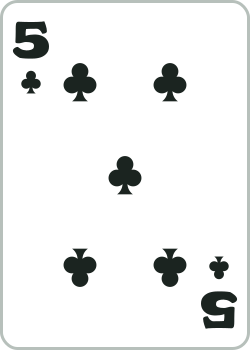
- The pieces pictured at the top of the page are our own example.
Spotted a mistake? Email [email protected] and we'll check it against the sources.