Solitaire rules
Solitaire is a card game you play alone. The one most people mean is Klondike. You deal 7 piles, then sort the whole deck onto 4 foundation piles, one for each suit, from ace up to king. On the way you move cards between the piles, building them down in alternating colors.
Also called Klondike, Klondike Solitaire, Patience.
- Players
- 1. Double Solitaire, further down, is for 2 or more.
- You need
- A standard 52-card deck, without the jokers
- Deal
- 28 cards in 7 piles of 1 to 7 cards, with the top card of each face up. The other 24 cards are the stock.
- Goal
- Build all 4 suits onto the foundations, each from ace up to king
- Game ends
- You win when all 52 cards are on the foundations. You lose when no move is left.
- Playing time
- About 5 to 15 minutes a game
Quick start
- Deal 7 piles in a row. Pile 1 gets 1 card and pile 7 gets 7, which is 28 cards. Only the top card of each pile is face up.
- Put the other 24 cards face down as the stock. Leave room for 4 foundations, one for each suit.
- On the piles, put a card on one that is one rank higher and the other color, such as a red 9 on a black 10. Runs of face-up cards can move together.
- When a pile has no face-up card left, turn its top card face up. Only a king can go into an empty pile.
- Turn stock cards 3 at a time onto a face-up waste pile, and play its top card when you can. When the stock runs out, turn the waste over and go again.
- Move each ace to a foundation as it comes free, then add the 2, 3 and so on in its suit. You win when all 52 cards are on the foundations.
Rule sheet and score sheet
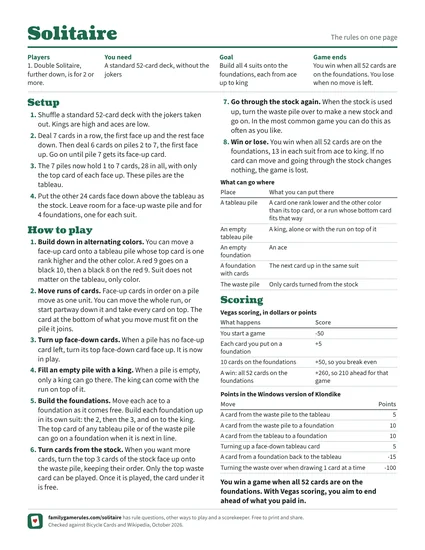
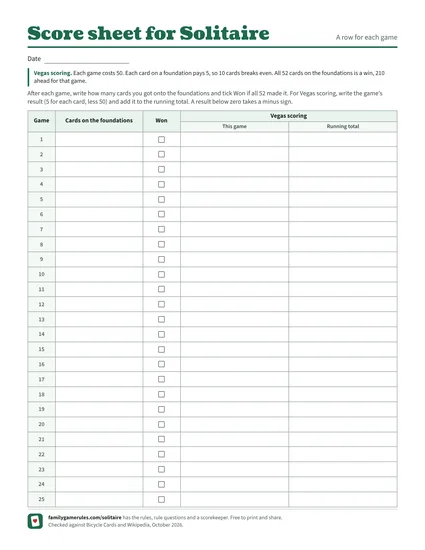
Print the whole game on one page, and a score sheet made for Solitaire. Both are free PDFs for Letter paper.
Setup
1 player. Double Solitaire, further down, is for 2 players with a deck each, or more when everyone plays at once.
You need: A standard 52-card deck with the jokers taken out.
| In the set | Count |
|---|---|
| Dealt into the 7 tableau piles (1 + 2 + 3 + 4 + 5 + 6 + 7) | 28 |
| Left over as the stock | 24 |
| Total | 52 |
- Cards rank from king, the highest, down to ace, the lowest.
- Spider uses two decks, 104 cards. Double Solitaire uses one deck for each player.
- Shuffle a standard 52-card deck with the jokers taken out. Kings are high and aces are low.
- Deal 7 cards in a row, the first face up and the rest face down. Then deal 6 cards on piles 2 to 7, the first face up. Go on until pile 7 gets its face-up card.
- The 7 piles now hold 1 to 7 cards, 28 in all, with only the top card of each face up. These piles are the tableau.
- Put the other 24 cards face down above the tableau as the stock. Leave room for a face-up waste pile and for 4 foundations, one for each suit.
Pile 1
1 card
Pile 2
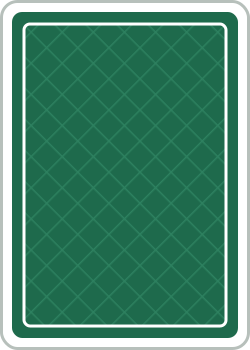
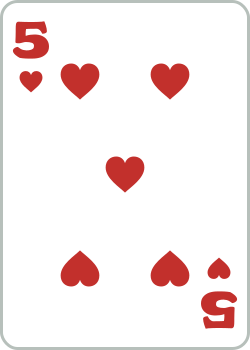
Pile 3
Pile 4
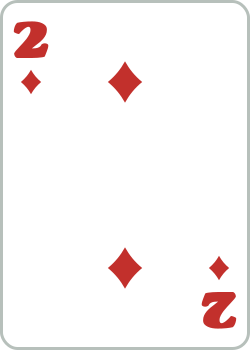
Pile 5
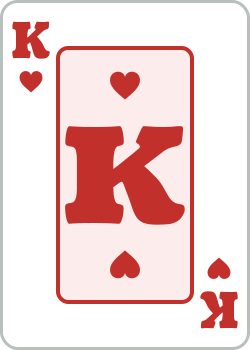
Pile 6
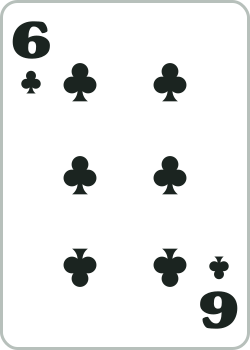
Pile 7
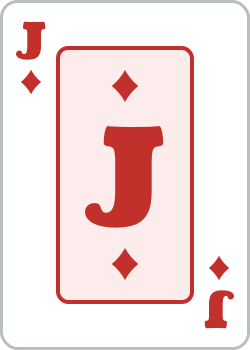
6 face down, 1 face up
Stock
24 cards, face down
- The 4 foundations and the waste pile start empty. The stock usually goes at the top left. The foundations go in a row above the piles as the aces come out.
How to play
There are no turns. You make any moves you like, in any order, until you win or get stuck.
-
Build down in alternating colors
You can move a face-up card onto a tableau pile whose top card is one rank higher and the other color. A red 9 goes on a black 10, then a black 8 on the red 9. Suit does not matter on the tableau, only color.
- Hearts and diamonds are red. Spades and clubs are black.
- Nothing can go on an ace in the tableau, because no card ranks lower.
-
Move runs of cards
Face-up cards in order on a pile move as one unit. You can move the whole run, or start partway down it and take every card on top. The card at the bottom of what you move must fit on the pile it joins.
- Some players say all the face-up cards on a pile must move together, never part of them. See the variants further down.
-
Turn up face-down cards
When a pile has no face-up card left, turn its top face-down card face up. It is now in play.
-
Fill an empty pile with a king
When a pile is empty, only a king can go there. The king can come with the run on top of it.
-
Build the foundations
Move each ace to a foundation as it comes free. Build each foundation up in its own suit: the 2, then the 3, and on to the king. The top card of any tableau pile or of the waste pile can go on a foundation when it is next in line.
- The printed rules we checked do not say whether a card can come back off a foundation. See the rule questions further down.
-
Turn cards from the stock
When you want more cards, turn the top 3 cards of the stock face up onto the waste pile, keeping their order. Only the top waste card can be played. Once it is played, the card under it is free.
- If the stock has only 1 or 2 cards left, turn those.
- Some players turn 1 card at a time. That makes the game easier. See the variants further down.
-
Go through the stock again
When the stock is used up, turn the waste pile over to make a new stock and go on. In the most common game you can do this as often as you like.
- Some groups limit the passes through the stock to 3, or to 1 when turning 1 card at a time. See the variants further down.
-
Win or lose
You win when all 52 cards are on the foundations, 13 in each suit from ace to king. If no card can move and going through the stock changes nothing, the game is lost.
| Place | What you can put there |
|---|---|
| A tableau pile | A card one rank lower and the other color than its top card, or a run whose bottom card fits that way |
| An empty tableau pile | A king, alone or with the run on top of it |
| An empty foundation | An ace |
| A foundation with cards | The next card up in the same suit |
| The waste pile | Only cards turned from the stock |
Example: move a run, free an ace, fill the space
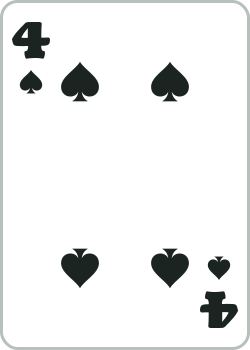
Pile 3 has 2 face-down cards under the 9 of hearts and the 8 of spades. Pile 6 has the 10 of clubs on top. The 9 of hearts is red and one lower than the black 10, so you move the 9 and the 8 together onto pile 6. Pile 3 has no face-up card left, so you turn up its top card. It is the ace of diamonds, which goes to a foundation. You turn up pile 3’s last card, the 7 of diamonds, and play it on the 8 of spades. Pile 3 is now empty. The king of clubs is on top of the waste pile, so you move it into the space.
Pile 3 before
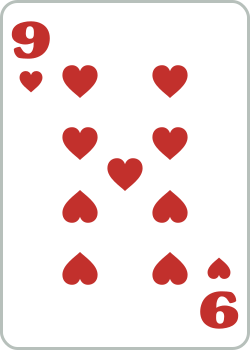
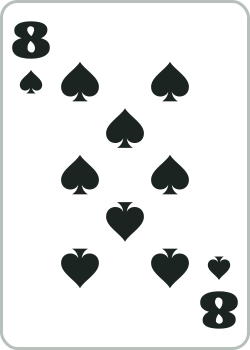
The 9 and 8 move together
Pile 6 before
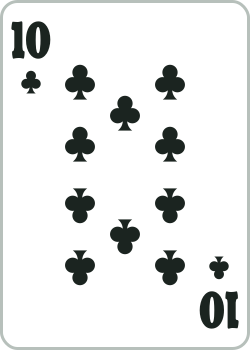
Waste pile
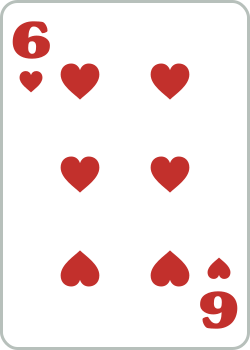
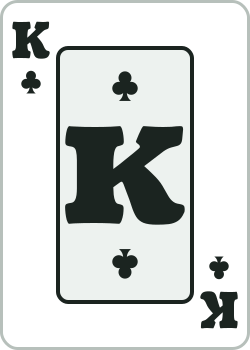
The king of clubs is on top
Pile 6 after
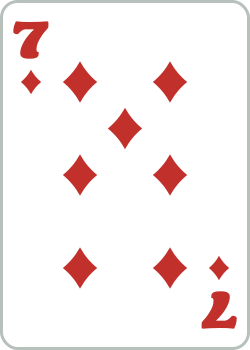
The run, then the 7 of diamonds from pile 3
Foundation
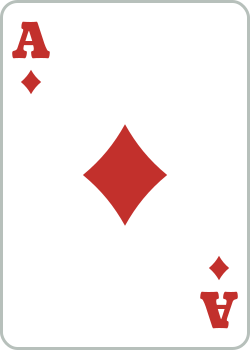
Turned up in pile 3
Pile 3 after
Only a king can fill the empty pile
Scoring
A game of Klondike is won or lost, and needs no score. For a score across many games, use Vegas scoring, which comes from casinos where people paid to play. Computer versions also have points systems of their own.
| What happens | Score |
|---|---|
| You start a game | -50 |
| Each card you put on a foundation | +5 |
| 10 cards on the foundations | +50, so you break even |
| A win: all 52 cards on the foundations | +260, so 210 ahead for that game |
| Move | Points |
|---|---|
| A card from the waste pile to the tableau | 5 |
| A card from the waste pile to a foundation | 10 |
| A card from the tableau to a foundation | 10 |
| Turning up a face-down tableau card | 5 |
| A card from a foundation back to the tableau | -15 |
| Turning the waste over when drawing 1 card at a time | -100 |
- In Vegas scoring you turn 1 card at a time and go through the stock only once.
- The rule sources we checked give a $50 stake and $5 a card as an example. Other numbers work too, as long as you keep them the same for every game.
- In the Windows points, the score never goes below 0.
You win a game when all 52 cards are on the foundations. With Vegas scoring, you aim to end ahead of what you paid in.
Write each game on its own line: the cards you got onto the foundations and whether you won. With Vegas scoring, add each game’s result to a running total.
A worked example: three games of Vegas scoring
Each game costs 50 and each card on a foundation pays 5. After game 1 you are 10 down. The win in game 2 puts you 200 up, and game 3 adds 25 more.
| What happened | Points |
|---|---|
| Game 1: pay to play | −50 |
| Game 1: 8 cards on the foundations, 5 each | 40 |
| Game 2: pay to play | −50 |
| Game 2: all 52 cards on the foundations, a win | 260 |
| Game 3: pay to play | −50 |
| Game 3: 15 cards on the foundations, 5 each | 75 |
| Running total | 225 |
Scorekeeper
Enter the cards you got onto the foundations after each game. It counts your games won and keeps a running Vegas total: each game costs 50 and each card pays 5. It works in this browser, keeps the game if the page reloads, and needs no account.
Other ways to play
Spider: the deal and the moves
Spider uses two 52-card decks shuffled together, 104 cards. Deal 54 cards in 10 piles: 6 cards in each of the first 4 piles and 5 in each of the other 6, with only the top card of each face up. The other 50 cards are the stock. You can put a card on any card one rank higher, of any suit or color. Cards move together only when they run in order in one suit, and you can move only the top part of a run and leave the rest behind. When a pile has no face-up card left, turn its next card up. An empty pile can take any card or any run that is free to move.
Spider: dealing the stock and winning
When you cannot or do not want to move, deal a row of 10 cards from the stock, face up, one on top of each pile. Every empty pile must be filled before you deal. The 50-card stock makes 5 rows of 10. When a pile holds all 13 cards of one suit in order, king down to ace, lift them off and set them aside. You win when all 8 suits have been cleared. Some printed rules deal 10 piles of 5 instead, with the top card of each face up. That leaves 54 cards in the stock, so after 5 rows of 10 the last deal is 4 cards, on the first 4 piles.
FreeCell
Deal the whole deck face up into 8 columns: 4 columns of 7 cards and 4 of 6. Above them are 4 free cells, each holding one card, and 4 foundations. Move one card at a time. The top card of a column or a card in a free cell can go onto a column whose top card is one rank higher and the other color, into an empty free cell, into an empty column, or onto its foundation. Any card can start an empty column. Build the foundations up by suit from the ace. You win when all 52 cards are on the foundations. Nearly every deal can be won.
FreeCell: moving several cards
The rules allow only one card at a time, but a run can move in one go when there is room to do it card by card, using empty free cells and empty columns to hold cards on the way. With no empty column, the most you can move at once is the number of empty free cells plus 1. Each empty column doubles that number, except a column the run is moving into.
Pyramid
Deal 28 cards face up in 7 rows: 1 card at the top, then 2 overlapping it, and so on to 7 at the bottom. The other 24 cards are the stock. A card is free when no card covers it. Remove any 2 free cards that add up to 13. A jack counts 11, a queen 12, an ace 1 and other cards their number. A king counts 13 and is removed alone. Turn the stock 1 card at a time. A stock card can pair with a free pyramid card, or it goes on a waste pile, and the top waste card can be paired later. Go through the stock once, unless you agree on redeals. You win only if every card is removed, stock included. Under the strictest rules, about 1 game in 50 is won.
Clock
Deal the deck face down into 13 piles of 4 cards. Set 12 of them in a circle like the hours on a clock, and put the 13th in the middle. Turn up the top card of the middle pile. Put it face up under the pile at its hour: an ace at 1 o’clock, 2 to 10 at their number, a jack at 11 and a queen at 12. A king goes under the middle pile. Then turn up the top face-down card of the pile you just added to, and place it the same way. You lose if the fourth king turns up while any card is still face down, and win if every card is face up. There are no choices to make, and on average 1 game in 13 is won.
Double Solitaire: taking turns
Each player has their own deck, with different backs if you can, and deals a Klondike layout: 7 piles of 1 to 7 cards, top cards face up, and a stock of 24. The 8 foundations go between the layouts, and anyone can build on any of them. The player whose 1-card pile shows the lower card goes first. On a tie, compare the 2-card piles, and so on. On your turn, make Klondike moves in your own layout and play cards to the foundations. You may not touch the other player’s piles or waste pile. When you cannot or will not move, turning your top stock card onto your waste pile ends your turn. The first player with all their cards on the foundations wins. If both players are stuck, the one with more cards on the foundations wins.
Double Solitaire: playing at once
In the fast way to play, nobody takes turns. Everyone plays at once, as quickly as they can, each using one hand only. When stuck, turn 3 cards from your stock. When your stock is empty, turn your waste pile over to make a new one. More players can join this way, each with their own deck and layout, and all the foundations are shared. The first player to get all their cards onto the foundations wins. If everyone is stuck, the player who has played the most cards wins.
House rules and other versions
- Turn 1 card at a time
- Turn the stock onto the waste pile 1 card at a time instead of 3. Every card in the stock can then be reached, so the game is easier.
- Limit the passes through the stock
- Go through the stock only 3 times, whether you turn 1 card or 3 at a time. The strictest form is a single pass, turning 1 card at a time and playing each card if you can.
- Move all the face-up cards together
- The face-up cards on a pile must move as one unit. You cannot leave some of them behind or move only the top few.
- Vegas solitaire
- Pay 50 to play a game, and get 5 back for each card you put on a foundation. Turn 1 card at a time and go through the stock once. See the scoring section for a worked example.
Rule questions
How many cards are in solitaire?
52, one standard deck without the jokers. Klondike deals 28 cards into 7 piles of 1 to 7 cards, with the top card of each face up. The other 24 cards are the stock. The game also has 4 foundations, one for each suit. Spider is different: it uses two decks, 104 cards.
Do you turn 1 card or 3 from the stock?
3 in the most common game. Only the top card of the waste pile can be played, so the cards under it wait until it is used. Turning 1 at a time is also played, and it makes the game easier. Agree before you start.
How many times can you go through the stock?
As many times as you like in the most common game. When the stock runs out, turn the waste pile over and keep going. The rule sources we checked also give limits of 3 passes, or a single pass when turning 1 card at a time, which is the Vegas rule. Agree before you start.
Can any card go into an empty pile?
No. In Klondike only a king can go into an empty pile, either alone or with the run of cards on top of it. Spider and FreeCell are different: any card or run that can move can fill an empty pile there.
Can you move part of a run?
Yes, under the rules on this page. You can pick up a run partway down, as long as you take every card on top of the card you start from. Some printed rules say all the face-up cards on a pile must move together. Agree before you play.
Can you take a card back off a foundation?
It depends on what you agree. The printed rules we checked do not say. The Windows version allows it but takes 15 points off for it. Settle it before you play.
Do you have to play an ace to a foundation right away?
Yes, on this page, following one set of printed rules we checked: each ace goes to a foundation as soon as it is free. Waiting never helps anyway, because no card can be put on an ace in the tableau.
How does Vegas solitaire scoring work?
You pay 50 to play each game and get 5 back for every card you put on a foundation. You turn 1 card at a time and go through the stock once. 10 cards gets your money back, and a full win of 52 cards pays 260.
What happens when you get stuck?
If no card can move and going through the stock again changes nothing, the game is over and you have lost. Gather the cards, shuffle and deal again. If you keep score, count the cards you got onto the foundations first.
Can every game of solitaire be won?
No. Nobody knows the exact odds for Klondike. One skilled player won 189 of 442 games, about 43 percent, and with only one pass through the stock about 1 game in 30 is won. Nearly every FreeCell deal can be won. Pyramid under the strictest rules is won about 1 time in 50, and Clock 1 time in 13.
Is solitaire the same as Klondike?
Yes, as most people use the word. In the United States and Canada, solitaire on its own means Klondike. In the UK, Klondike is often called patience.
In Double Solitaire, can you play on the other player’s cards?
Only on the foundations. All 8 foundations are shared, so either player can add the next card to any of them. You may not play on or take from the other player’s piles or waste pile.
Words used in Solitaire
- Tableau
- The 7 piles dealt at the start. You move cards between them, building down in alternating colors.
- Foundations
- The 4 piles, one for each suit, that you build up from ace to king. Filling them wins the game.
- Stock
- The 24 cards left face down after the deal. You turn them up onto the waste pile.
- Waste pile
- The face-up pile of cards turned from the stock. Only its top card can be played. Also called the discard pile.
- Build down
- Put a card on one that is one rank higher, such as a 7 on an 8. Klondike’s tableau is built down in alternating colors.
- Build up
- Put a card on one that is one rank lower in the same suit, such as the 3 of hearts on the 2 of hearts. Foundations are built up.
- Run
- Face-up cards on a pile that go down in order and alternate in color. A run can move as one unit.
- Pass
- One trip through the whole stock. Turning the waste pile over to start again begins a new pass.
- Space
- An empty tableau pile. In Klondike only a king can fill it.
- Free cell
- In FreeCell, one of 4 spaces that each hold a single card for a while.
- Patience
- What Klondike is often called in the UK.
What you need
- A standard deck of playing cardsOne 52-card deck is enough for Klondike, FreeCell, Pyramid and Clock.Find it on Amazon (A standard deck of playing cards, opens in a new tab)
- A second deckFor Spider, which uses 104 cards, or for Double Solitaire. Different backs help in Double Solitaire.Find it on Amazon (A second deck, opens in a new tab)
- Mini patience cardsOptional. Small cards that fit a 7-pile layout on a tray table or a small desk.Find it on Amazon (Mini patience cards, opens in a new tab)
As an Amazon Associate, we earn from qualifying purchases. How the site is paid for.
Checked against
These rules are written in our own words from Bicycle Cards and checked against Wikipedia. Sources last checked on October 12, 2026.
- First source: Bicycle Cards, Klondike. The 52-card pack, the 28-card deal in 7 piles with the top card face up, aces to the foundations, building up by suit, building down in alternating colors, face-up cards moving as a unit, turning up face-down cards, kings only in a space, and turning the stock 3 at a time.
- Second source: Wikipedia, Klondike (solitaire). Used in place of a Pagat page, since Pagat has no Klondike page and links to this article. The layout, alternating colors, moving part of a run, a king or a king-led pile in a space, the dealing options and passes, the most common option, Vegas scoring at 50 a game and 5 a card, the Windows points, the names, and the odds.
Other sources we used (7)
- Bicycle Cards, Solitaire. Bicycle’s beginner page for the same game: the deal row by row, card ranks with the ace low, turning over stock cards one at a time, and the waste pile.
- Bicycle Cards, Spider Solitaire. Spider: two packs, building down in any suit, moving runs in one suit, filling every space before a deal, rows of 10 from the stock, lifting off full suits, and its own deal of 10 piles of 5 with a last deal of 4.
- Wikipedia, FreeCell. FreeCell, which neither Bicycle nor Pagat covers: 8 columns of 7 and 6 cards, 4 free cells, one card at a time, multi-card moves and the odds.
- Wikipedia, Pyramid (solitaire). Pyramid, which neither Bicycle nor Pagat covers: the 28-card pyramid, pairs adding to 13, kings alone, the stock and waste pile, redeals as a variation, winning and the odds.
- Wikipedia, Clock (card game). Clock, which neither Bicycle nor Pagat covers: 12 piles of 4 in a circle and 4 in the middle, placing cards by hour, the fourth king and the 1 in 13 odds.
- Pagat, Double Solitaire. Double Solitaire: a deck each, shared foundations, who starts, turns ending with a stock card, the blocked game, the simultaneous version, and turning the waste over to make a new stock.
- Wikipedia, Spider (solitaire). Spider’s usual deal: 54 cards in 10 piles of 6 and 5 with the top card of each face up, and a 50-card stock dealt 10 at a time when no pile is empty.
Where the sources differ (8)
| Topic | Bicycle Cards | Wikipedia | This page |
|---|---|---|---|
| Turning cards from the stock | Turns the stock in groups of three. Bicycle’s beginner Solitaire page describes turning over one card at a time. | Lists both ways in five combinations with passes, and calls three at a time with no limit on passes the most common. | 3 at a time in the main rules. Turning 1 at a time is a variant and a rule question. |
| Passes through the stock | Not stated. The beginner Solitaire page does not say either. | No limit, 3 passes, or a single pass, depending on the dealing option. The single pass with 1 card at a time is the casino form. | No limit in the main rules, following Wikipedia’s most common option. 3 passes and a single pass are a variant and a rule question. The way to start a new pass, turning the waste over, is worded from Pagat’s Double Solitaire page. |
| Moving part of a run | All face-up cards on a pile must be moved as a unit. | Every face-up card in a partial pile, or a complete pile, can be moved as a unit. | Follows Wikipedia, since part of a run may move. Bicycle’s rule is a variant and is named in a rule question. |
| Filling an empty pile | Only a king may fill a space. | A king, or a pile of cards headed by a king. | The two agree. The page says a king, alone or with the run on top of it. |
| Turning up face-down cards | When no face-up card is left on a pile, its top face-down card is turned up. | Not stated beyond the deal. | Follows Bicycle. |
| Aces | Each ace must be played to the foundations as it becomes available. | Not stated. | The play step says to move each ace as it comes free. A rule question gives Bicycle’s rule. |
| Scoring | None. | Vegas: pay $50 to play and get $5 for each card on the foundations, turning 1 card at a time with one pass. Also the Windows points table. | Vegas scoring as a scoring table, a variant and the scorekeeper, with the Windows points as a second table. Wikipedia gives the $50 and $5 as an example, and the page says so. |
| Color on the tableau | Opposite color, one rank lower. Bicycle’s beginner Solitaire page never mentions color. | Built down by alternate colors. | Alternating colors. |
What on this page is our own
- The playing time of about 5 to 15 minutes a game is our estimate.
- The stock of 24 cards is our arithmetic (52 less 28). Pagat’s Double Solitaire page states the same 24 for each player’s layout.
- The Vegas break-even at 10 cards, the 260 for a full win, the 210 net and the three-game example are our arithmetic and our own example.
- The example stretch of play, the setup layout and the pieces pictured at the top of the page are our own.
- That the top card of the waste pile stays playable later is our reading. Bicycle says only that the card below a played card becomes available. Pagat’s Double Solitaire page lets a player move cards from their waste pile.
- The remark that waiting to play an ace never helps is our reasoning from the rules.
- That turning 1 card at a time makes the game easier is our reasoning. Wikipedia’s figures show a much higher win rate for draw one than draw three.
- The note that the stock usually goes at the top left follows Wikipedia, and the foundations in a row above the piles follow Bicycle. Usually is our word.
- In Pyramid, the ace counting 1 and number cards counting their number is our reading of Wikipedia, which gives values for the jack, queen and king and pairs a queen with an ace.
- In FreeCell, each free cell holding one card is our reading of Wikipedia’s ‘an empty cell’. Which 4 columns get 7 cards is not stated, so the page does not say.
- In Spider, the 5 rows of 10 from Wikipedia’s 50-card stock, and the 54 cards left in the stock after Bicycle’s 10 piles of 5, are our arithmetic.
- In Clock, dealing 13 piles of 4 and setting the 13th in the middle restates Wikipedia’s 12 piles of 4 in a circle and 4 cards in the center.
- Double Solitaire’s 8 foundations are our arithmetic from Pagat’s 4 per player. That Double Solitaire players use Klondike moves and the 2-player layout is Pagat’s.
- The notes under What you need describe products and are not rules.
- In Pyramid, going through the stock once is our reading of Wikipedia, which gives redeals as a variation.
- That part of a run may move, leaving face-up cards behind, is our reading of Wikipedia’s rule that every face-up card in a partial pile can be moved as a unit.
Spotted a mistake? Email [email protected] and we'll check it against the sources.