Bunco rules
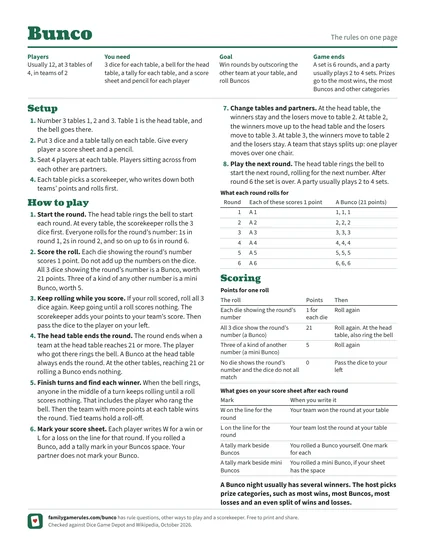
Bunco is a dice party game, usually played by 12 people at 3 tables of 4, in teams of 2. Each round has a number from 1 to 6, and you score for every die that shows it. Three of that number is a Bunco. When a team at the head table reaches 21, a bell ends the round.
Also called Bunko, Bonko, Buncko.

- Players
- Usually 12, at 3 tables of 4, in teams of 2
- You need
- 3 dice for each table, a bell for the head table, a tally for each table, and a score sheet and pencil for each player
- Each turn
- Roll 3 dice. Score 1 point for each die showing the round’s number, and keep rolling until a roll scores nothing
- Goal
- Win rounds by outscoring the other team at your table, and roll Buncos
- Game ends
- A set is 6 rounds, and a party usually plays 2 to 4 sets. Prizes go to the most wins, the most Buncos and other categories
- Playing time
- 30 minutes to several hours
Quick start
- Set up 3 tables of 4 players. Partners sit across from each other. Table 1 is the head table and has the bell. Each table gets 3 dice.
- A set has 6 rounds. Round 1 rolls for 1s, round 2 for 2s, and so on up to 6s. The head table rings the bell to start each round.
- On your turn, roll 3 dice. Each die showing the round’s number scores 1 point. Three of that number is a Bunco, worth 21. Three of another number scores 5.
- Keep rolling while you score. When a roll scores nothing, pass the dice to your left. Each table’s scorekeeper keeps both teams’ points.
- When a team at the head table reaches 21, it rings the bell. Anyone in the middle of a turn finishes it, even the bell ringer. The team with more points at each table wins.
- Mark W or L on your score sheet and tally your Buncos. Then change tables and partners for the next round. Prizes go to the most wins, the most Buncos and more.
Rule sheet and score sheet
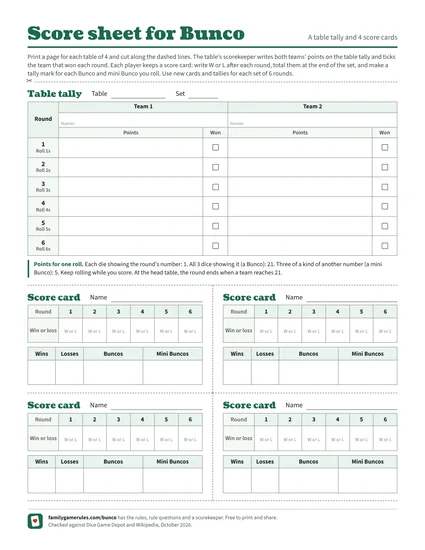
Print the whole game on one page, and a score sheet made for Bunco. Both are free PDFs for Letter paper.
Setup
12 is the usual number: 3 tables of 4, with partners sitting across from each other. Ways to play with fewer than 12 and with 16 or more are further down.
You need: 9 six-sided dice: 3 for each of the 3 tables.
| In the set | Count |
|---|---|
| Dice for the head table (table 1) | 3 |
| Dice for table 2 | 3 |
| Dice for table 3 | 3 |
| Total | 9 |
- You also need a bell for the head table, a table tally for each table, and a score sheet and a pencil for each player.
- For the optional Traveling rule, add a fuzzy die, a small beanbag or another soft object that is safe to toss.
- Number 3 tables 1, 2 and 3. Table 1 is the head table, and the bell goes there.
- Put 3 dice and a table tally on each table. Give every player a score sheet and a pencil.
- Seat 4 players at each table. Players sitting across from each other are partners.
- Each table picks a scorekeeper, who writes down both teams’ points and rolls first.
Head table (table 1)

The bell is here
Table 2
Table 3
- The head table is also called the high table or the queen’s table.
How to play
All 3 tables play the same round at once. Each round has a number from 1 to 6, and only dice showing that number score. The head table decides when the round ends for everyone.
-
Start the round
The head table rings the bell to start each round. At every table, the scorekeeper rolls the 3 dice first. Everyone rolls for the round’s number: 1s in round 1, 2s in round 2, and so on up to 6s in round 6.
-
Score the roll
Each die showing the round’s number scores 1 point. Do not add up the numbers on the dice. All 3 dice showing the round’s number is a Bunco, worth 21 points. Three of a kind of any other number is a mini Bunco, worth 5.
- Call out “Bunco” when you roll one. The rules we follow give the 21 points only to a player who calls it.
- A Bunco is worth 21 in all. It does not also earn 1 point for each of its 3 dice.
- Some rules give no name to three of a kind of another number. They still score it at 5.
Two 4s

2 points
Three 4s: a Bunco
21 points
Three 6s: a mini Bunco

5 points
No 4 and no three of a kind



No points. Pass the dice
Four rolls in round 4, where the dice are rolling for 4s. -
Keep rolling while you score
If your roll scored, roll all 3 dice again. Keep going until a roll scores nothing. The scorekeeper adds your points to your team’s score. Then pass the dice to the player on your left.
- A mini Bunco scores, so you roll again after it. So does a Bunco, even one that ends the round at the head table.
- There is no limit on the number of rolls in a turn.
-
The head table ends the round
The round ends when a team at the head table reaches 21 or more. The player who got there rings the bell. A Bunco at the head table always ends the round. At the other tables, reaching 21 or rolling a Bunco ends nothing.
- Teams at tables 2 and 3 can go past 21. They keep playing until the head table rings the bell.
- A team can win a round without rolling any Buncos.
-
Finish turns and find each winner
When the bell rings, anyone in the middle of a turn keeps rolling until a roll scores nothing. That includes the player who rang the bell. Then the team with more points at each table wins the round. Tied teams hold a roll-off.
- In a roll-off, the scorekeeper rolls first and the dice go around the table. Each player takes one turn, rolling for the round’s number as usual. If one team is ahead once everyone has rolled, that team wins. If not, go around again until the tie is broken.
-
Mark your score sheet
Each player writes W for a win or L for a loss on the line for that round. If you rolled a Bunco, add a tally mark in your Buncos space. Your partner does not mark your Bunco.
- Some score sheets also have a space for mini Buncos.
- Both partners on the winning team write W, and both partners on the losing team write L.
-
Change tables and partners
At the head table, the winners stay and the losers move to table 2. At table 2, the winners move up to the head table and the losers move to table 3. At table 3, the winners move to table 2 and the losers stay. A team that stays splits up: one player moves over one chair.
- After the moves, each table again has 4 players. Each table then chooses a scorekeeper for the next round. Passing the job around lets everyone roll first sometimes.
- The rules we follow do not say whether a team that moves to a new table keeps the same partners there. Agree on it before you start.
-
Play the next round
The head table rings the bell to start the next round, rolling for the next number. After round 6 the set is over. A party usually plays 2 to 4 sets.
- Each new set starts again at round 1, rolling for 1s.
- The rules we follow say to keep playing until all the rounds are done, or until your group decides to stop.
| Round | Each of these scores 1 point | A Bunco (21 points) |
|---|---|---|
| 1 | A 1 | 1, 1, 1 |
| 2 | A 2 | 2, 2, 2 |
| 3 | A 3 | 3, 3, 3 |
| 4 | A 4 | 4, 4, 4 |
| 5 | A 5 | 5, 5, 5 |
| 6 | A 6 | 6, 6, 6 |
Example: one turn in round 3
It is round 3, so you are rolling for 3s. Your first roll is 3, 5 and 3. Two dice show 3, so you score 2 points and roll again. Next you roll 6, 6 and 6. That is three of a kind of a number other than 3, a mini Bunco worth 5 points, so you roll again. Then you roll 1, 4 and 2. No die shows a 3 and the dice do not match, so the roll scores nothing. Your turn ends with 7 points for your team, and you pass the dice to the player on your left.
Roll 1
Two 3s: 2 points. Roll again
Roll 2
A mini Bunco: 5 points. Roll again
Roll 3
No points. Turn total 7. Pass the dice left
Scoring
Points count only inside a round. They decide which team wins at each table, and every team starts the next round at 0. What carries through the night is each player’s own record of wins, losses and Buncos.
| The roll | Points | Then |
|---|---|---|
| Each die showing the round’s number | 1 for each die | Roll again |
| All 3 dice show the round’s number (a Bunco) | 21 | Roll again. At the head table, also ring the bell |
| Three of a kind of another number (a mini Bunco) | 5 | Roll again |
| No die shows the round’s number and the dice do not all match | 0 | Pass the dice to your left |
| Mark | When you write it |
|---|---|
| W on the line for the round | Your team won the round at your table |
| L on the line for the round | Your team lost the round at your table |
| A tally mark beside Buncos | You rolled a Bunco yourself. One mark for each |
| A tally mark beside mini Buncos | You rolled a mini Bunco, if your sheet has the space |
- After the last round, count your W marks and L marks and write the totals in the Wins and Losses spaces.
- The points on the table tally are each team’s score for that round only. They do not carry over to the next round.
A Bunco night usually has several winners. The host picks prize categories, such as most wins, most Buncos, most losses and an even split of wins and losses.
Each table’s scorekeeper writes both teams’ points on the table tally after every turn. When the round ends, every player marks W or L on their own score sheet, and anyone who rolled a Bunco adds a tally mark. Prizes are decided from the score sheets at the end of the night.
A worked example: your team’s round
Round 2 at table 2, so 2s score. You and your partner Sam are one team. Here is every roll your team made. When the head table rang the bell, the other team at your table had 14 points. Your team’s 29 wins the round. You and Sam both write W for round 2, and Sam adds a tally mark for the Bunco.
| What happened | Points |
|---|---|
| Your turn, roll 1: 2, 2, 5. Two 2s | 2 |
| Your turn, roll 2: 2, 4, 6. One 2 | 1 |
| Your turn, roll 3: 4, 4, 4. A mini Bunco | 5 |
| Your turn, roll 4: 1, 3, 6. Nothing, so you pass the dice | 0 |
| Sam’s turn, roll 1: 2, 2, 2. A Bunco. Sam calls it and rolls again | 21 |
| Sam’s turn, roll 2: 3, 5, 6. Nothing, so Sam passes the dice | 0 |
| Your team | 29 |
Scorekeeper
Keeps one table’s two teams through a set of 6 rounds. It shows the round’s number, adds the points from each roll to the team that rolled, with 21 for a Bunco and 5 for a mini Bunco, and counts each team’s Buncos. At the end of each round, mark which team won. At the head table, the round ends when a team reaches 21. It works in this browser, keeps the game if the page reloads, and needs no account.
Other ways to play
Bunco for 8 players
Use 2 tables of 4. Table 1 is the head table, with the bell, and its first team to 21 ends each round as usual. After each round, the head table’s winners stay and its losers move to table 2. Table 2’s winners move up to the head table, and its losers stay. A team that stays splits up, with one player moving over one chair.
Bunco for 11 players
Set up 3 tables as usual, with one empty seat. The official rules call the missing player a Ghost. The Ghost moves between tables like anyone else. Each round, the Ghost’s partner rolls twice: once on their own turn and once on the Ghost’s. The rest of the game is played as usual.
Table plans for 5 to 10 players
One boxed set has table plans for groups that are not a multiple of 4. It plays with 4 dice, and each table plays on to 21 by itself, unless a Bunco ends the round at every table. With 5 players, 3 sit alone at table 1 and 2 at table 2. With 6, 4 play in teams at table 1 and 2 alone at table 2. With 7, it is 4 in teams and 3 alone. With 9, add 2 alone at table 3. With 10, tables 1 and 2 have teams and 2 play alone at table 3. For 5, 6, 9 and 10, losers move down a table and everyone at the last table moves to table 1. It gives no moves for 7.
Bunco at one table
A single table of 4 can play. That table works as the head table: partners sit across from each other, and the first team to reach 21 wins the round. Nobody changes tables, so to change partners between rounds, have one player move over one chair. Mark wins, losses and Buncos as usual. One boxed set has its own game for 2 to 4 players at one table. Each player rolls 4 dice and plays alone, and the first player to reach 21 wins the round.
Bunco for 16 or more players
Add a table of 4 for every 4 extra players, with 3 dice at each, and number the tables from the head table down. The head table still ends every round. The rules we checked differ on the moves, so agree on them first. One way: winners move up one table, except at the head table, where they stay. Losers move down one table, except at the bottom table, where they stay. Another way: the winning team at each table below the head table moves up one table, and the head table’s losers drop to the bottom table. The other losing teams stay, so every table keeps 4 players.
The official rules
The official rules use the same rounds, points and moves as the main rules on this page, with these differences. A party is always 4 sets, with a break after the first 2. Each table gets 2 tally pads, and one player on each team keeps that team’s points. After the bell, players at the other tables may finish their turns. The official rules do not say this for the head table. A fuzzy die starts at the head table. A tie for a prize is settled by a roll-off, and the highest roll wins. An empty seat can be filled by a Ghost, as in the 11-player version.
House rules and other versions
- Head table losers drop to the bottom
- Some groups send the losing team at the head table all the way down to the lowest table. The winners at every other table move up one table.
- Any Bunco wins the round
- Some rules end each round as soon as a player reaches 21 points, so rolling a Bunco wins the round on the spot.
- Traveling
- First pick a three of a kind, such as 2, 2, 2 in any round. Whoever rolls it calls “Traveling” and is tossed the fuzzy die to keep until the next Traveling. The holder at the end wins a prize. In one boxed set, whoever rolls a Bunco gets the fuzzy die. The official rules give its prize to the last Bunco roller holding it.
- Shorter rounds
- For a shorter game, play each round to 11 points instead of 21.
- Four dice
- One boxed party set uses 4 dice. Each die showing the round’s number still scores 1 point. Four of the round’s number is a Bunco for 21, and a Bunco at any table ends the round for everyone. Four of a kind of a lower number scores 5, and four of a higher number scores 7.
Rule questions
How many points is a Bunco?
21. A Bunco is all 3 dice showing the round’s number, such as three 5s in round 5. Call out “Bunco” to claim it. The 21 points go to your team’s score for the round, and you mark the Bunco on your own score sheet.
What does three of a kind of another number score?
5 points. Three of a kind that does not match the round’s number, such as three 6s in round 4, is called a mini Bunco. It counts as a scoring roll, so you roll again.
Does a Bunco end the round?
Only at the head table. There a Bunco puts the team at 21 or more, so the player rings the bell and the round ends. That player still rolls on until a roll scores nothing. At the other tables the player scores 21 and keeps rolling. Some rules have any Bunco win the round at once.
Do you add up the numbers on the dice?
No. Only dice showing the round’s number count, at 1 point each. In round 2, a roll of 2, 2 and 6 scores 2 points, not 10.
What happens at the other tables when the bell rings?
The round stops there too, after any turn in progress. A player who is rolling keeps going until a roll scores nothing. Then the team with more points at each table wins the round, even if neither team has reached 21.
What if both teams at a table have the same score?
Hold a roll-off. The scorekeeper rolls first, and each player at the table takes one turn rolling for the round’s number. If one team is ahead after everyone has rolled, it wins the round. If it is still tied, go around again.
Does my partner also get credit for my Bunco?
No. Only the player who rolled the Bunco puts a tally mark in the Buncos space. Your partner shares the points for the round and the W if your team wins, but not the Bunco.
Who moves to which table?
The head table’s winners stay and its losers go to table 2. Table 2’s winners move up to the head table and its losers go to table 3. Table 3’s winners move to table 2 and its losers stay. A team that stays splits up, with one player moving over one chair.
How many rounds are in a game of Bunco?
A set is 6 rounds, one for each number on a die, starting with 1s. A party usually plays 2 to 4 sets.
Who wins at the end of the night?
There are usually several winners. The host chooses prizes, such as most wins, most Buncos, most losses, wins and losses equal, or the last Bunco of the night. If you want a single winner, it is the player with the most wins. Some groups break a tie with total points, and one boxed set uses the most Buncos.
Can you play Bunco with fewer or more than 12 players?
Yes. Use one table for every 4 players, with 3 dice at each. Eight players use 2 tables, and 4 players can play at one. With 11, one player also rolls for a missing partner, called a Ghost. The official rules use a Ghost to fill an empty seat. One boxed set has table plans for 5 to 10 players. The versions further down give the details, including moves for more than 3 tables.
Is it Bunco or Bunko?
Both. The game is also spelled Bunko, Bonko or Buncko.
Words used in Bunco
- Bunco
- All 3 dice showing the round’s number. It scores 21 points, and the player calls it out.
- Mini Bunco
- Three of a kind of a number other than the round’s number. It scores 5 points.
- Round
- One stretch of play in which everyone rolls for the same number, from 1 in round 1 to 6 in round 6.
- Set
- 6 rounds, one for each number from 1 to 6. A party usually plays 2 to 4 sets.
- Head table
- Table 1, where the bell sits. Its first team to 21 ends the round for every table. Also called the high table or the queen’s table.
- Table tally
- The sheet at each table where the scorekeeper writes both teams’ points for the round.
- Score sheet
- Each player’s own card, with a W or L for every round and spaces to tally Buncos and total the wins and losses.
- Scorekeeper
- The player at each table who keeps the table tally and rolls first in the round.
- Roll-off
- Extra turns that settle a tied round, with each player rolling once until one team is ahead.
- Traveling
- An optional rule where a player who rolls a chosen three of a kind calls out “Traveling” and gets a fuzzy die. Whoever holds it at the end wins a prize.
What you need
- Dice3 for each table, so 9 for 3 tables. Any six-sided dice work.Find it on Amazon (Dice, opens in a new tab)
- A bellFor the head table. Any bell that can be heard across the room works.Find it on Amazon (A bell, opens in a new tab)
- Bunco score sheets and table talliesOne score sheet for each player and one tally for each table, each round. You can also print the sheets from this site.Find it on Amazon (Bunco score sheets and table tallies, opens in a new tab)
- A Bunco party setOptional. Sets usually come with dice, a bell and score pads.Find it on Amazon (A Bunco party set, opens in a new tab)
- A fuzzy dieOptional, for the Traveling rule.Find it on Amazon (A fuzzy die, opens in a new tab)
As an Amazon Associate, we earn from qualifying purchases. How the site is paid for.
Checked against
These rules are written in our own words from Dice Game Depot and checked against Wikipedia. Sources last checked on October 12, 2026.
- First source: Dice Game Depot, Bunco Rules, printable rules (6 pages, undated). Equipment, the head table and bell, 3 dice for each table, partners across, the scorekeeper rolling first, 6 rounds to a set and 2 to 4 sets, 1 point a die, the Bunco at 21, the mini Bunco at 5, rolling again, passing left, the round ending at the head table at 21, finishing turns after the bell, the roll-off, the score sheet marks, who moves where, prizes and Traveling. Its 3-table moves are also applied to 8 players and to 16 or more, and its head-table rules to a single table..
- Second source: Wikipedia, Bunco. 3 dice, 6 rounds, 1 point a die, 21 for a Bunco, 5 for three of a kind of another number, rolling again, 12 or more players in groups of 4, teams of 2, the queen’s table, the round ending when a player reaches 21, the head table losers dropping to the bottom table, the overall winner and tie-break, other spellings and the playing time.
Other sources we used (2)
- Fundex Games, Bunco Party (item 3840) instructions, copy hosted by ManualsDir. A boxed set’s rules for 11 players, its one-table game, its table plans and moves for 5 to 10 players, rounds to 11 points, the 4-dice version with its high and low Buncos, passing the scorekeeper job around, a fuzzy die passed for Buncos, the prize list and the overall tie-break on Buncos.
- World Bunco Association, Official Bunco Rules (copyright 1996). Read in full after the page was first written. Used for 4 players a table and 3 dice for each table added, the Ghost for a missing player, the fuzzy die’s prize, and its own rules summed up in a version: 4 sets, 2 tally pads a table with one tallier a team, finishing turns at the other tables, the fuzzy die starting at the head table, and a roll-off for a tied prize. Its scores, moves and Bunco tally marks match Dice Game Depot’s..
Where the sources differ (10)
| Topic | Dice Game Depot | Wikipedia | This page |
|---|---|---|---|
| When a round ends | When a team at the head table reaches at least 21 points. The player who got there rings the bell. Other tables play on until the bell. | When a player has scored 21 points, which makes a Bunco an instant win. It does not mention the head table ending the round or a bell. | Follows Dice Game Depot. The Wikipedia rule is listed as a variant. |
| A Bunco at a table other than the head table | Scores 21 and the player keeps rolling. Only at the head table does it end the round. | Ends the round at once. | Follows Dice Game Depot, with the Wikipedia rule as a variant and in a rule question. |
| Where the head table’s losers go | To table 2. Table 2’s losers go to table 3, table 3’s losers stay, and winners move up one table except at the head table, where they stay. | Winners move to the next-highest table, and the head table’s losers drop to the lowest table. It says nothing about other losing teams. | Follows Dice Game Depot. The Wikipedia move is a variant and one of the two ways given for 16 or more players. |
| Length of a game | A game is 2 to 4 sets of 6 rounds. | A game is 6 rounds. | A set is 6 rounds, and a party usually plays 2 to 4 sets. |
| Who wins the night | There are usually several winners, from prize categories the host chooses. | The player with the most rounds won, with ties usually broken by total points. | Prizes in the main text. Most wins, with the tie-breaks, is given in a rule question. |
| Number of players | Traditionally 12 at 3 tables of 4, but almost any number can play. | 12 or more in groups of 4. Its summary box says 2 or more, usually in teams of 2. | 12 as the usual number, with versions for 2 to 11 players and for 16 or more. |
| Bell, scorekeeper, calling Bunco, score sheets and changing partners | All covered: the bell starts and ends rounds, the scorekeeper rolls first, a Bunco must be called out, players mark W, L and Buncos, and a team that stays splits up. | None of these is mentioned. | Follows Dice Game Depot. |
| A tied round | A roll-off, with each player taking a turn until one team leads. | Not covered. | Follows Dice Game Depot. |
| Who rolls first and which way | The scorekeeper rolls first, and the dice pass to the left. | The dice pass to the next player. No first roller is named. | Follows Dice Game Depot. |
| Name of the head table | The head table, also called the High Table or table #1. | The head table or the queen’s table. | Head table, with both other names in a setup note and in the terms. |
What on this page is our own
- The examples, the rolls pictured in the play step and at the top of the page, and their arithmetic are our own.
- Dice Game Depot’s printable rules, from a shop that sells dice games, are the first source. The World Bunco Association’s official rules were added later as an extra source. Where they differ, the page keeps Dice Game Depot’s rules and sums up the association’s in a version.
- Upper limit of 16 players and the 4-player minimum in the page data are our own caps for sorting games. The page text gives versions for 2 to 11 players and for 16 or more.
- These points are our reading and are not stated outright: a Bunco is 21 in all and not 21 plus 3, there is no limit on rolls in a turn, both partners mark W or L, table points reset each round, and each new set starts at round 1.
- Dice Game Depot lists a Last Bunco prize without explaining it. The page reads it as the last Bunco rolled that night.
- The 8-player moves are our application of Dice Game Depot’s 3-table moves to 2 tables. The boxed set moves 8 players its own way, with losing teams moving on a table and winning teams staying.
- The 4-player team game at one table is our application of the head-table rules. The World Bunco Association says only to use fewer tables, with 4 players at each.
- For 16 or more players, the moving-down-one-table way is our extension of Dice Game Depot’s 3-table moves. Adding a table of 4 with 3 dice for every 4 players follows the World Bunco Association. In the other way, the other losing teams staying is our reading. Wikipedia does not say, and it is the only way every table keeps 4 players.
- The advice to agree on whether a moving team stays together is ours. No source says.
- Calling the most-wins player the single winner follows Wikipedia and the boxed set. Dice Game Depot names no single winner.
- The notes under What you need describe products and are not rules. The score sheet and scorekeeper layout are our own.
- One Dice Game Depot sentence says a player who rolls a Bunco keeps rolling unless at the head table, where she rings the bell. That can be read as ending her turn. Its round-end rule says the player who rang the bell keeps rolling until a roll scores nothing, and the page follows that rule.
- The one-line summary of the boxed set’s moves for 5, 6, 9 and 10 players is our wording of its separate rule for each count.
Spotted a mistake? Email [email protected] and we'll check it against the sources.