Shut the Box rules
Shut the Box is a dice game played with a tray of tiles numbered 1 to 9. You roll 2 dice and shut tiles that add up to the roll, again and again, until a roll cannot be matched. The tiles left open are your score, and the lowest score wins. Shut every tile and you win at once.
Also called Canoga.





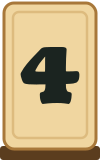

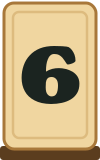
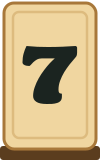
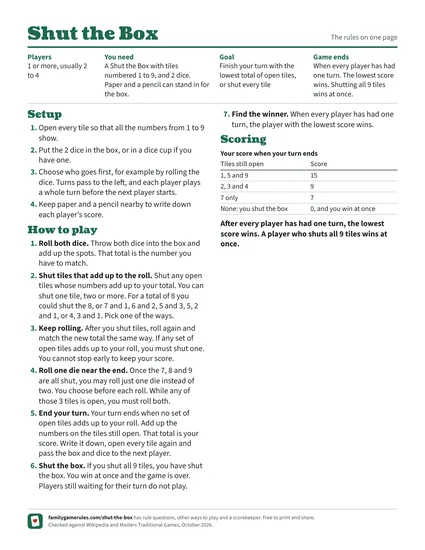
- Players
- 1 or more, usually 2 to 4
- You need
- A Shut the Box with tiles numbered 1 to 9, and 2 dice. Paper and a pencil can stand in for the box.
- Each turn
- Roll 2 dice, shut open tiles that add up to the roll, and roll again until a roll cannot be matched
- Goal
- Finish your turn with the lowest total of open tiles, or shut every tile
- Game ends
- When every player has had one turn. The lowest score wins. Shutting all 9 tiles wins at once.
- Playing time
- About 2 to 3 minutes for each player
Quick start
- Open all 9 tiles so the numbers 1 to 9 show. Choose who goes first. Each player takes one whole turn, then passes the box and dice to the left.
- On your turn, roll both dice and add them up. Shut any open tiles whose numbers add up to that total, such as the 9 and the 3 for a roll of 12.
- Roll again and shut more tiles the same way. Keep going for as long as each roll can be matched.
- Once the 7, 8 and 9 are all shut, you may roll one die instead of two. It is your choice.
- Your turn ends when no open tiles add up to your roll. Your score is the total of the tiles still open. Open every tile for the next player.
- After everyone has had a turn, the lowest score wins. If you shut all 9 tiles, you have shut the box and win at once.
Rule sheet and score sheet
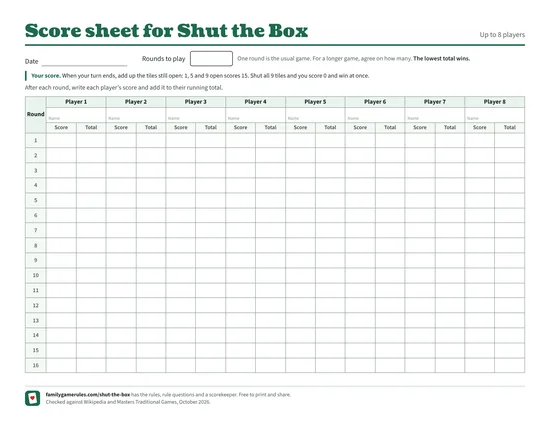
Print the whole game on one page, and a score sheet made for Shut the Box. Both are free PDFs for Letter paper.
Setup
1 or more players, each playing alone and sharing one box. It is usually played by 2 to 4. Notes on playing alone and on boxes for 4 players are further down.
You need: A Shut the Box tray with 9 numbered tiles, and 2 dice.
| In the set | Count | Worth when scoring |
|---|---|---|
| Tiles numbered 1 to 9 | 9 | The number on the tile, if it is still open when your turn ends |
| Six-sided dice | 2 | |
| Total | 11 |
- Each tile flips, slides or swings to cover its number. A tile showing its number is open. A covered tile is shut.
- Some boxes have 10 or 12 tiles, and some have a row of tiles for each of 4 players.
- With no box, write the numbers 1 to 9 on paper and use 2 dice. A dice cup is optional.
- Open every tile so that all the numbers from 1 to 9 show.
- Put the 2 dice in the box, or in a dice cup if you have one.
- Choose who goes first, for example by rolling the dice. Turns pass to the left, and each player plays a whole turn before the next player starts.
- Keep paper and a pencil nearby to write down each player’s score.
The tiles

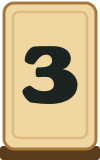
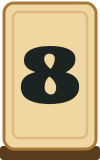
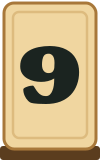
Every tile open
The dice

- No official body sets the rules, and groups play the game in many ways. This page gives the usual rules and lists the common changes further down.
How to play
Each player has one turn. A turn is a string of rolls, and it lasts until a roll cannot be matched with the tiles still open.
-
Roll both dice
Throw both dice into the box and add up the spots. That total is the number you have to match.
- You must roll both dice while the 7, the 8 or the 9 is still open.
-
Shut tiles that add up to the roll
Shut any open tiles whose numbers add up to your total. You can shut one tile, two or more. For a total of 8 you could shut the 8, or 7 and 1, 6 and 2, 5 and 3, 5, 2 and 1, or 4, 3 and 1. Pick one of the ways.
- The tiles do not have to match the dice. With a 6 and a 2 you can shut the 6 and the 2, or the 8 alone, or any other set of open tiles that makes 8.
- Every tile you use must still be open. Once a tile is shut, it stays shut for the rest of your turn and cannot count toward a later roll.
You rolled


Total 8
The tiles after you shut 7 and 1


A roll of 5 and 3 makes 8. Here the 7 and the 1 are shut to match it. -
Keep rolling
After you shut tiles, roll again and match the new total the same way. If any set of open tiles adds up to your roll, you must shut one. You cannot stop early to keep your score.
- There is no limit on the number of rolls in a turn.
-
Roll one die near the end
Once the 7, 8 and 9 are all shut, you may roll just one die instead of two. You choose before each roll. While any of those 3 tiles is open, you must roll both.
- Some groups allow one die only once the open tiles add up to less than 6. That rule is listed with the variants further down.
-
End your turn
Your turn ends when no set of open tiles adds up to your roll. Add up the numbers on the tiles still open. That total is your score. Write it down, open every tile again and pass the box and dice to the next player.
- If you roll 3 and the 3 tile is shut, the 1 and the 2 can still make 3, but only if both are open.
-
Shut the box
If you shut all 9 tiles, you have shut the box. You win at once and the game is over. Players still waiting for their turn do not play.
- In a longer game of several rounds, the rule sources we checked do not say whether shutting the box wins the whole game or only the round. With no tiles open, the score for that round is 0. Agree on it before you start.
-
Find the winner
When every player has had one turn, the player with the lowest score wins.
- The rule sources we checked give no tie-break for the regular game. Agree on it first. One simple way is for the tied players to take one more turn each.
- For a longer game, play several rounds and keep a running total for each player. Two ways to do this are listed with the variants.
Example: one turn, three rolls
All 9 tiles are open. You roll a 6 and a 6, which makes 12, and shut the 9 and the 3. Next you roll a 5 and a 5, which makes 10, and shut the 8 and the 2. Then you roll a 2 and a 1, which makes 3. The 3 is shut, and so is the 2, so the 1 and the 2 cannot make 3 either. Nothing else adds up to 3, so your turn is over. The 7 is still open, so you rolled both dice every time.
Roll 1

12: shut the 9 and the 3
After roll 1
Roll 2
10: shut the 8 and the 2
After roll 2
Roll 3


3: no open tiles add up to 3, so the turn ends
Scoring
Each player scores once, when their turn ends. The score is the total of the tiles still open, and low is good.
| Tiles still open | Score |
|---|---|
| 1, 5 and 9 | 15 |
| 2, 3 and 4 | 9 |
| 7 only | 7 |
| None: you shut the box | 0, and you win at once |
| Tiles still open | Main rule: add them up | Read them as a number | Count the tiles |
|---|---|---|---|
| 1, 5 and 9 | 15 | 159 | 3 |
| 1, 2 and 5 | 8 | 125 | 3 |
| 4 and 6 | 10 | 46 | 2 |
- The best possible score is 0, which means you shut the box.
- Write each player’s score down before the tiles are opened for the next player.
After every player has had one turn, the lowest score wins. A player who shuts all 9 tiles wins at once.
Write down each player’s score when their turn ends. For a longer game of several rounds, add each round’s score to a running total for each player.
A worked example: scoring the turn above
The turn in the example above ended with the 1, 4, 5, 6 and 7 still open. Add them up for a score of 23. In the version that reads the open tiles as one number, the same box would score 14567.
Tiles at the end of the turn
1 + 4 + 5 + 6 + 7 = 23
| What happened | Points |
|---|---|
| Tile 1, open | 1 |
| Tile 4, open | 4 |
| Tile 5, open | 5 |
| Tile 6, open | 6 |
| Tile 7, open | 7 |
| Tiles 2, 3, 8 and 9, shut | 0 |
| Your score | 23 |
Scorekeeper
After each round, enter each player’s score: the total of their open tiles, or 0 for a player who shut the box. In the usual one-round game the lowest score wins. For a longer game, keep adding rounds. It keeps a running total for each player and shows who is lowest. Watch for 45 or 100 if you play one of those versions. It works in this browser, keeps the game if the page reloads, and needs no account.
Other ways to play
Shut the Box alone
Shut the Box works as a one-player game. Play a turn by the usual rules and try to shut all 9 tiles. If you cannot, your score is the total of the tiles left open, and you can try to beat it on your next turn.
The long game for 2 players
The first player plays a turn by the usual rules, trying to shut the box. When that turn ends, the second player takes over the box just as it is. They try to open every shut tile, each time opening shut tiles that add up to the roll. A player who throws a double gets an extra turn. The first player to shut the box or open it all the way wins. The rules do not say what happens when the second player is stopped, so agree on it first, such as passing the box back and forth.
Boxes for 4 players
Some boxes have 4 rows of tiles, one row for each player, and some come with 4 pairs of dice. Play by the usual rules, each player shutting tiles in their own row. With only 2 dice, or with dice all the same color, take turns throwing the dice and shutting tiles until you cannot go on. If each player has a pair of dice in a different color and the middle of the box has room, everyone throws at the same time until they cannot go on.
House rules and other versions
- Read the tiles as a number
- Instead of adding up the open tiles, read them from left to right as one number. Open tiles 1, 5 and 9 score 159 instead of 15. The lowest score still wins.
- Count the open tiles
- Your score is how many tiles are still open, whatever their numbers. Three open tiles score 3. The lowest score wins. This version is called Missionary.
- Several rounds, out at 45
- Play several rounds. After each round, add each player’s score to their running total. A player whose total reaches 45 drops out. The last player left in wins.
- Several rounds to 100
- Play rounds and keep a running total for each player. When someone’s total reaches 100 or more, the player with the lowest total wins. One description of this game also puts players out at 45, which does not fit with the end at 100, so choose one rule.
- One die only at the very end
- Some groups allow one die only once the open tiles add up to less than 6. Until then you roll both dice, even with the 7, 8 and 9 shut.
- 2 to go and 3 to go
- All 9 tiles start open, and your first roll must shut the 2. A player whose first roll adds up to 4 loses at once. In 3 to go, the 3 must be shut on the first roll instead. The rules say only that it is otherwise the same as 2 to go, so agree first on which first roll, if any, loses.
- Start with some tiles shut
- Some games begin with tiles already shut. In one, the 1, 2 and 3 start shut, so only the 4 to 9 are in play. In another, only the odd tiles start open. In a third, only the even tiles start open.
- Shut one tile a roll
- Always roll both dice. After each roll, shut just one tile: a tile that matches one of the dice, or the tile for the two dice added together.
- A simpler game for young children
- This needs a box with tiles for at least 2 players. Players take turns. After rolling both dice, shut the tile for the total, or the tile for one die, or the tiles for both dice. Keep rolling and shutting tiles. The rules do not say when a turn passes. Agree on it before you start. The first player to shut all their tiles wins.
- Playing for stakes
- In English pubs the game is often played for money. Each player pays an agreed amount into a pot at the start, and the round’s winner takes it. A player who shuts the box receives double the stake from every player. Agree whether they also take the pot. In the version called Canoga, each loser pays the winner the difference between their scores.
Rule questions
Do you have to roll one die when the 7, 8 and 9 are shut?
No. Once those 3 tiles are all shut, you choose whether to roll one die or two, and you can choose again before each roll. While any of the 7, 8 or 9 is open, you must roll both. Some groups allow one die only once the open tiles add up to less than 6.
Can you shut tiles that are not the numbers on the dice?
Yes. Only the total counts. If you roll a 5 and a 3, you can shut the 8, or 7 and 1, 6 and 2, 5 and 3, 5, 2 and 1, or 4, 3 and 1. Any open tiles that add up to 8 will do, and you can shut more than 2 tiles.
Can you stop rolling and keep your score?
No. If any open tiles add up to your roll, you must shut them and roll again. Your turn ends only when a roll cannot be matched.
Can a shut tile be used again later in the turn?
No. Every tile you shut must be open at the time. A shut tile stays shut until your turn is over. Then all the tiles are opened again for the next player.
What happens if you shut the box?
You win at once. Shutting all 9 tiles ends the game, and anyone still waiting for a turn does not play. When the game is played for stakes, you also receive double the stake from every player.
How do you score Shut the Box?
Add up the numbers on the tiles still open when your turn ends. If the 1, 5 and 9 are open, you score 15. The lowest score wins. A less common way reads the open tiles as one number, so the same tiles score 159.
Is Shut the Box one round or several?
One round in the usual rules. Each player has one turn, and the lowest score wins. For a longer game, add up each player’s scores over several rounds. In one version a player drops out at 45 and the last one left wins. In another the game ends when someone reaches 100, and the lowest total wins.
What if two players tie for the lowest score?
The rule sources we checked give no tie-break for the regular game. Agree before you start. One simple way is for the tied players to take one more turn each, and the lower score wins. In Canoga, the version played for stakes, tied winners split the payout, or it is multiplied for each winner, as agreed before the game.
How many people can play Shut the Box?
Any number, from 1 up. It is usually played by 2 to 4, who take turns with one box. Some boxes have 4 rows of tiles so that 4 players each have their own.
How do you play with a box of 10 or 12 tiles?
Boxes with 10 or 12 tiles are made, but the rule sources we checked give no separate rules for them. Play the usual way, with more tiles to shut. Agree first on when one die is allowed, since the usual rule names only the 7, 8 and 9.
Can you play Shut the Box without a box?
Yes. All you need is 2 dice, a pen and paper. Write the numbers 1 to 9 and cross them off as you shut them.
Words used in Shut the Box
- Tile
- One of the numbered pieces in the box, from 1 to 9. Each one can be open or shut. Also called a flap.
- Open
- A tile that still shows its number. It can be shut, and it counts against you when your turn ends.
- Shut
- A tile that has been flipped or slid to cover its number. It cannot be used again that turn.
- Shut the box
- To shut all 9 tiles in one turn. It wins at once.
- Turn
- All of one player’s rolls, from the first until a roll cannot be matched.
- Round
- One turn for each player.
- Canoga
- Another name for Shut the Box. It is also the name of a version played for stakes.
What you need
- A Shut the Box gameA tray with tiles numbered 1 to 9 and 2 dice. Some have 10 or 12 tiles, or a row of tiles for each of 4 players.Find it on Amazon (A Shut the Box game, opens in a new tab)
- A pair of diceOptional. Any six-sided dice work if the ones from the box go missing.Find it on Amazon (A pair of dice, opens in a new tab)
- A score pad and pencilOptional. Useful for a longer game of several rounds. You can also print the score sheet from this site.Find it on Amazon (A score pad and pencil, opens in a new tab)
As an Amazon Associate, we earn from qualifying purchases. How the site is paid for.
Checked against
These rules are written in our own words from Wikipedia and checked against Masters Traditional Games. Sources last checked on October 12, 2026.
- First source: Wikipedia, Shut the box. The box of tiles 1 to 9 and boxes with 10 or 12, the turn, shutting any tiles that add up to the roll, the one-die rule, the score as the total of open tiles, shutting the box, one round with the lowest score winning, players, playing time, playing with pen and paper, and most of the variants.
- Second source: Masters Traditional Games, The Rules of Shut the Box. Confirms the turn, the ways to make 8, the one-die rule and the scoring example of 15. The less common score read as a number, shutting the box, players, the name Canoga, stakes in pubs, the long game for 2, rounds to 45, one die below 6 and boxes for 4 players.
Other sources we used (1)
- Jaques of London, Shut the Box: How to Play, Where It Comes From, and the Best Set to Buy. Every tile standing open at the start of a turn, and the maker’s own box with tiles 1 to 12.
Where the sources differ (11)
| Topic | Wikipedia | Masters Traditional Games | This page |
|---|---|---|---|
| Longer games | Under Tournament: rounds scored by adding the open tiles until someone reaches 100 or more, when the lowest total wins. The same entry also says a player whose score reaches 45 drops out and the last player left wins. | Round scores are added up. A player drops out on reaching 45, and the last player left wins. | One round is the main game, as both sources give it. Both longer games are variants. The 100-point game carries a note that the 45 rule in the same entry does not fit with it. |
| Reading the open tiles as a number | A named variant, Digital: tiles 1, 2 and 5 left open score 125. | Occasionally used: tiles 1, 5 and 9 left open score 159. | Adding up is the main rule. Reading as a number is a variant, a rule question and a column of the second scoring table. |
| Shutting the box | The player wins at once and the game is over. | The player wins outright at once and receives double the stake from all players. | You win at once and the game is over. The double stake is in the stakes variant. Whether it wins a whole game of several rounds is a note, since neither source says. |
| When one die may be rolled | A player with none of 7, 8 and 9 still open may choose one die or two. | The same, as the player’s choice. Some people allow one die only once the open tiles total less than 6. | Follows both. The less-than-6 rule is a variant. |
| Adding the dice | The player adds up “(or subtracts)” the spots, with no further explanation. | The player adds up the spots. | Adds them up. Subtracting is left out, since the first source never says how it would work. |
| Number of tiles | Tiles 1 to 9. Boxes with 10 or 12 tiles exist. Gives no separate rules for them. | Tiles 1 to 9 only. Mentions boxes with 4 sets of tiles. | 9 tiles. Boxes of 10 or 12 are in a rule question. Jaques of London confirms it makes a 12-tile box. |
| Players | 1 or more, commonly 2 to 4. | Any number, best with 2, 3 or 4. Some play solo. | 1 or more, usually 2 to 4. |
| Opening the tiles for each player | All tiles start open at the start of the game. A reset for each player is not stated. | Not stated. | Every tile is opened again for each player, as in Jaques of London’s steps, which begin each turn with all the tiles standing open. |
| Who goes first | Not stated for the main game. In Canoga, players roll to see who goes first and play passes clockwise. | Not stated. | Choose who goes first, for example by rolling, and pass to the left. |
| Variants listed | Lists many, including Missionary, 2 to go, 3 to go, 3 down extreme, Against all odds, Even Stevens, Thai style, Lucky number 7, Unlucky number 7, Full house, The 300, 2012, Canoga, Canoga XII, a simpler game for young players, and versions played with dominoes or cards. | Lists the long game for 2, rounds to 45, one die below 6, and scoring by reading the tiles as a number. | Lists those that can be stated clearly. Lucky and Unlucky number 7, Full house, The 300, 2012, Canoga XII and the domino and card versions are left out because the first source gives too little to play them by. |
| Playing time | 2 to 3 minutes per player. | Not stated. | About 2 to 3 minutes for each player. |
What on this page is our own
- The upper limit of 8 players in the page data is our own cap for sorting games by player count. Both main sources say any number can play.
- The example turn, the example roll of 5 and 3, the scoring example and the pieces pictured at the top of the page are our own. The scores in the tables are our arithmetic, except 15 and 159, which come from Masters Traditional Games, and 125, which comes from Wikipedia.
- Choosing who goes first, for example by rolling, and passing to the left are our suggestions. Neither main source covers them for the main game.
- The tie-break suggestion is ours. No source gives a tie-break for the regular game. Wikipedia covers tied winners only in Canoga, where the payout is “split between or among the winners or multiplied for each winner”.
- That players still waiting for their turn do not play once someone shuts the box is our reading of Wikipedia’s “the game is over”. No source says it directly.
- That a player who shuts the box scores 0 for that round is our arithmetic. Whether it wins a longer game is left to the players because no source says.
- Playing a 10- or 12-tile box the usual way is our suggestion. No source gives rules for those boxes.
- In the solo version, trying to beat your own score is our suggestion. The sources say only that the game can be played alone.
- In the long game, opening shut tiles that add up to each roll is our reading of the source’s “exactly the same rules”. Passing the box back and forth when the second player is stopped is our suggestion.
- In the simpler game for young children, reading Wikipedia’s “2 player box” as a box with a row of tiles for each player, and players each shutting their own tiles, are our reading.
- In the simpler game for young children, Wikipedia does not say when a player’s turn passes to the next player. Agreeing on it before you start is our suggestion.
- Crossing the numbers off on paper is our wording of Wikipedia’s note that the game can be played with dice, pen and paper.
- That the 45 drop-out does not fit with the end at 100 is our reasoning: a player who is out at 45 can never reach 100.
- Reading Masters Traditional Games’ 4 sets of flaps as a row of tiles for each player is ours.
- The scorekeeper and score sheet layouts are ours. The notes under What you need describe products and are not rules.
- Reading 2 to go’s “rolls a four” as a first roll whose dice add up to 4 is ours. It is the one total the 2 tile cannot be part of.
- In 3 to go, which first roll loses, if any, is left to the players. Wikipedia says only that it is the same as 2 to go with the 3 dropped instead.
- No source says whether a player who shuts the box in stakes play also takes the pot. Agreeing on it first is our suggestion.
Spotted a mistake? Email [email protected] and we'll check it against the sources.