Phase 10 rules
Phase 10 is a rummy-style card game for 2 to 6 players with its own 108-card deck. In each round you try to collect one combination of cards, called a phase, and lay it down. The 10 phases must be completed in order. A player who misses a phase repeats it next round, so players are often on different phases.

- Players
- 2 to 6
- Ages
- 7 and up
- You need
- A Phase 10 deck of 108 cards, plus paper and a pencil
- Deal
- 10 cards each. The rest are the draw pile, with its top card turned face up beside it.
- Each turn
- Draw 1 card, lay down your phase and add cards to phases on the table when you can, then discard 1 card
- Goal
- Be the first to complete all 10 phases, in order
- Game ends
- At the end of the round in which a player completes Phase 10. A tie goes to the fewest points.
- Playing time
- 1 to 2 hours
Phase 10 is a trademark of Kenneth R. Johnson in the United States and Mattel, Inc. in other countries. Mattel publishes the game. This site is not affiliated with or endorsed by Kenneth R. Johnson or Mattel.
Quick start
- Deal 10 cards to each player from the 108-card deck. Put the rest face down as the draw pile, and turn its top card face up to start the discard pile.
- On your turn, draw the top card of the draw pile or of the discard pile. End your turn by discarding 1 card.
- Everyone starts on Phase 1: 2 sets of 3, such as three 7s and three 10s. When you hold your whole phase, lay it face up on the table during your turn.
- After your phase is down, get rid of your other cards by hitting. That means adding cards that fit to any phase on the table.
- The round ends when one player has no cards left. Everyone else scores points for the cards still in their hand. A low score is better.
- Players who laid down their phase move to the next one. The rest repeat theirs. Whoever completes Phase 10 first wins when that round ends. Ties go to the fewest points.
Rule sheet and score sheet
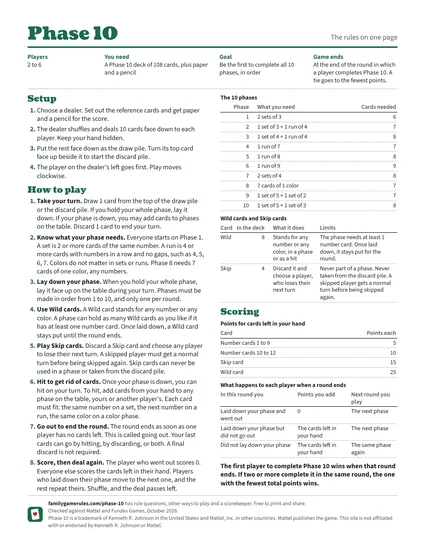
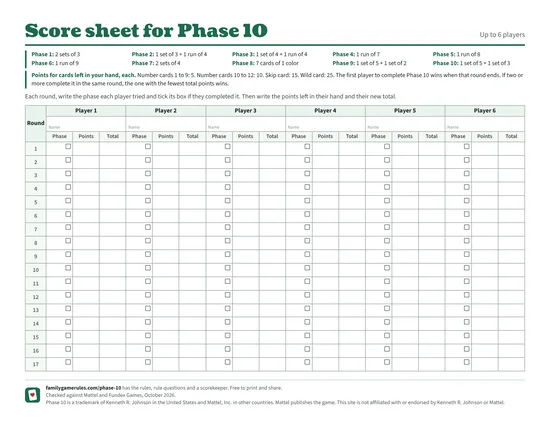
Print the whole game on one page, and a score sheet made for Phase 10. Both are free PDFs for Letter paper.
Setup
2 to 6 players, each playing alone. The rules are the same for every number of players.
You need: One Phase 10 deck of 108 cards.
| In the set | Count | Worth when scoring |
|---|---|---|
| Number cards: two each of 1 to 12 in red, blue, yellow and green | 96 | 1 to 9 are 5 each. 10 to 12 are 10 each. |
| Wild cards | 8 | 25 each |
| Skip cards | 4 | 15 each |
| Total | 108 |
- Each color has 24 number cards, so the deck holds 8 of every number.
- The box also holds reference cards that list the 10 phases. They are not part of the deck. The rule sheet counts 2 of them, which is why it says 110 cards.
- In older decks the Wild cards come in all four colors and the Skip cards are blue. Those colors mean nothing in play.
- Some editions change a color. The 40th anniversary deck has orange cards in place of blue ones.
- Choose a dealer. Set out the reference cards and get paper and a pencil for the score.
- The dealer shuffles and deals 10 cards face down to each player. Keep your hand hidden.
- Put the rest face down as the draw pile. Turn its top card face up beside it to start the discard pile.
- The player on the dealer’s left goes first. Play moves clockwise.
Each player’s hand
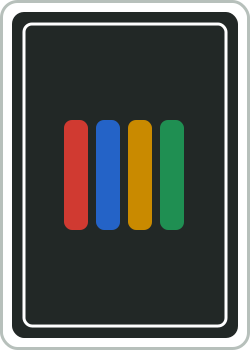
Draw pile
The rest of the deck, face down
Discard pile
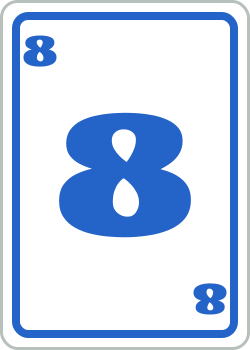
1 card, face up
- If the card turned up to start the discard pile is a Skip card, the first player loses their first turn.
- If that card is a Wild card, the first player may take it.
- The rules leave the choice of the first dealer to you.
How to play
Phase 10 is played in rounds. In each round you try to complete the one phase you are on, then get rid of the rest of your cards.
-
Take your turn
Draw 1 card from the top of the draw pile or the discard pile. If you hold your whole phase, lay it down. If your phase is down, you may add cards to phases on the table. Discard 1 card to end your turn.
- Only the top card of the discard pile can be taken, and never a Skip card. A Wild card on top can be taken.
-
Know what your phase needs
Everyone starts on Phase 1. A set is 2 or more cards of the same number. A run is 4 or more cards with numbers in a row and no gaps, such as 4, 5, 6, 7. Colors do not matter in sets or runs. Phase 8 needs 7 cards of one color, any numbers.
- When a phase asks for 2 sets, both can be the same number. Three 10s and three more 10s make a legal Phase 1.
A set of 3
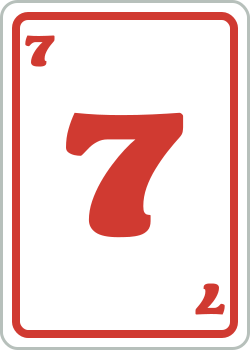
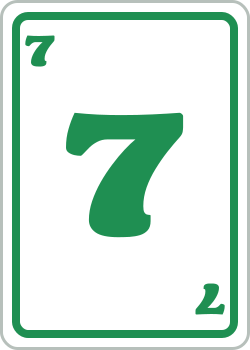
Same number, any colors
A run of 4
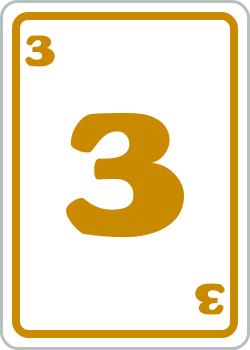
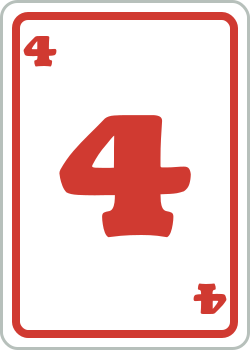
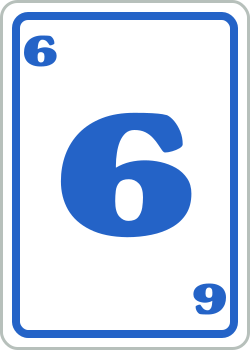
Numbers in a row with no gaps, any colors
7 cards of 1 color
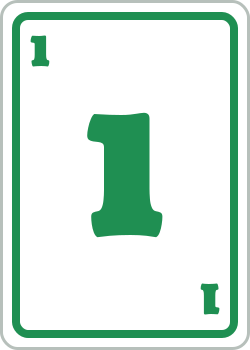
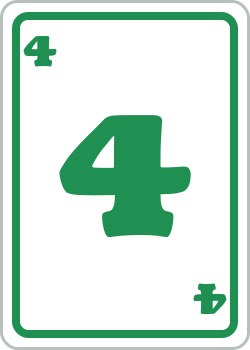
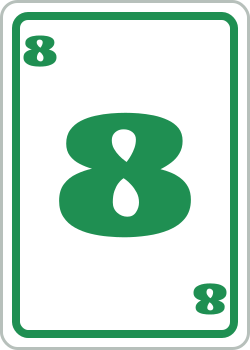
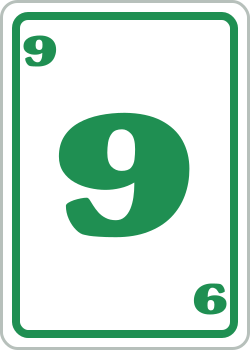
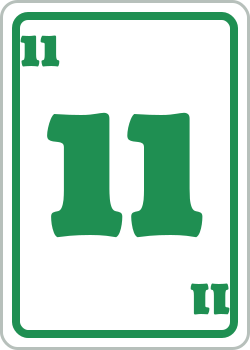
Same color, any numbers
The three kinds of groups that phases are built from. -
Lay down your phase
When you hold your whole phase, lay it face up on the table during your turn. Phases must be made in order from 1 to 10, and only one per round.
- You cannot lay down part of a phase now and the rest on a later turn.
- You get credit for the phase as soon as it is on the table. It does not matter who ends the round.
- Extra cards that fit your phase can be added on the same turn. With three 5s, three 7s and two more 5s, all eight cards can go down at once.
- Cards laid down for one phase never count toward a later one. A run of 9 laid down for Phase 4 does not also cover Phases 5 and 6.
-
Use Wild cards
A Wild card stands for any number or any color. A phase can hold as many Wild cards as you like if it has at least one number card. Once laid down, a Wild card stays put until the round ends.
- With a 3, a 4 and a 6, a Wild card can be the 5 that completes a run of 4.
- The rules ask for one number card in the whole phase. They do not ask for one in every set or run.
-
Play Skip cards
Discard a Skip card and choose any player to lose their next turn. A skipped player must get a normal turn before being skipped again. Skip cards can never be used in a phase or taken from the discard pile.
- Playing a Skip card counts as your discard, so it ends your turn.
- You can hold a Skip card and play it on a later turn.
-
Hit to get rid of cards
Once your phase is down, you can hit on your turn. To hit, add cards from your hand to any phase on the table, yours or another player’s. Each card must fit: the same number on a set, the next number on a run, the same color on a color phase.
- You may hit on the same turn you lay down your phase, with as many cards as you can.
- A run can grow at either end. On a run of 3, 4, 5, 6 you could add a 2, or a 7 and then an 8.
- A Wild card can be used for any hit.
- After your phase is down, your turns go on as before: draw first, hit if you can, then discard.
-
Go out to end the round
The round ends as soon as one player has no cards left. This is called going out. Your last cards can go by hitting, by discarding, or both. A final discard is not required.
- Nobody can go out before laying down their phase, because hitting is not allowed until then.
-
Score, then deal again
The player who went out scores 0. Everyone else scores the cards left in their hand. Players who laid down their phase move to the next one, and the rest repeat theirs. Shuffle, and the deal passes left.
| Phase | What you need | Cards needed |
|---|---|---|
| 1 | 2 sets of 3 | 6 |
| 2 | 1 set of 3 + 1 run of 4 | 7 |
| 3 | 1 set of 4 + 1 run of 4 | 8 |
| 4 | 1 run of 7 | 7 |
| 5 | 1 run of 8 | 8 |
| 6 | 1 run of 9 | 9 |
| 7 | 2 sets of 4 | 8 |
| 8 | 7 cards of 1 color | 7 |
| 9 | 1 set of 5 + 1 set of 2 | 7 |
| 10 | 1 set of 5 + 1 set of 3 | 8 |
| Card | In the deck | What it does | Limits |
|---|---|---|---|
| Wild | 8 | Stands for any number or any color, in a phase or as a hit | The phase needs at least 1 number card. Once laid down, it stays put for the round. |
| Skip | 4 | Discard it and choose a player, who loses their next turn | Never part of a phase. Never taken from the discard pile. A skipped player gets a normal turn before being skipped again. |
Example: laying down Phase 2
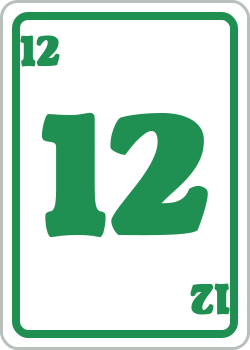
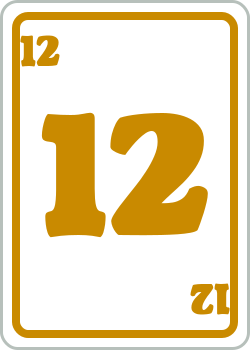
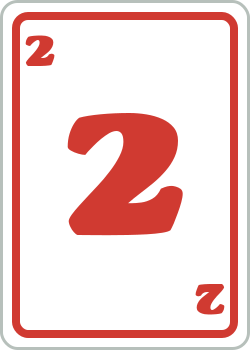
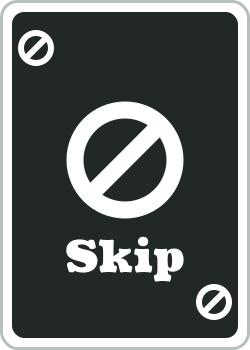
You are on Phase 2, which needs 1 set of 3 and 1 run of 4. You draw and now hold the 11 cards shown. The two 9s and the Wild card make the set. The 4, 5, 6 and 7 make the run. You hold the whole phase, so you lay both groups face up. Now that your phase is down, you may hit on this same turn, and the green 8 goes on the end of your run. That leaves a 12, a 2 and a Skip card. Discard one of them to end your turn. If it is the Skip card, choose a player to lose their next turn. Next round you play Phase 3, even if someone else goes out first.
Your hand after drawing
Laid down: a set of 3
The Wild card stands for a 9
Laid down: a run of 4
Colors can be mixed
Your hit
Added to the end of your run
Still in your hand
Discard one to end your turn
Scoring
In Phase 10 a low score is good. The player who goes out scores 0. Every other player scores the cards still in their hand. Cards on the table never count.
| Card | Points each |
|---|---|
| Number cards 1 to 9 | 5 |
| Number cards 10 to 12 | 10 |
| Skip card | 15 |
| Wild card | 25 |
| In this round you | Points you add | Next round you play |
|---|---|---|
| Laid down your phase and went out | 0 | The next phase |
| Laid down your phase but did not go out | The cards left in your hand | The next phase |
| Did not lay down your phase | The cards left in your hand | The same phase again |
- Laying down Phase 10 does not end the game on the spot. The round is played until someone goes out, so more than one player can complete Phase 10 in it.
- If the players who completed Phase 10 are also tied on points, they replay Phase 10 against each other. The first to go out wins.
The first player to complete Phase 10 wins when that round ends. If two or more complete it in the same round, the one with the fewest total points wins.
Use paper and a pencil. Scores carry over from round to round, so keep a running total of points for each player. Write down which phase each player is on as well.
A worked example: counting the cards you are caught with
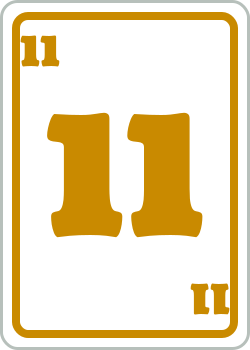
You are on Phase 4 and never completed your run of 7. Another player goes out while you still hold all 10 cards: a 1, a 3, a 4, a 7, an 8, a 9, an 11, a 12, a Skip card and a Wild card. You add 90 points to your total and try Phase 4 again next round.
1 to 9: 5 points each
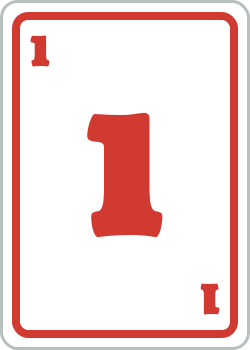
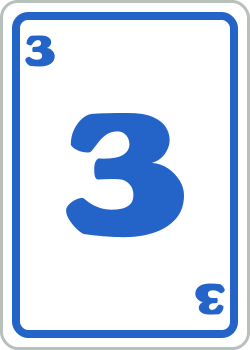
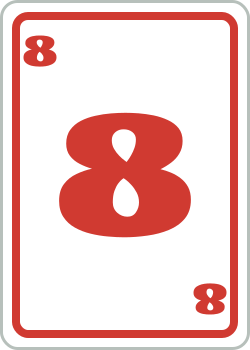
10 to 12: 10 points each
Skip: 15 points
Wild: 25 points
| What happened | Points |
|---|---|
| 6 cards numbered 1 to 9, at 5 points each | 30 |
| 2 cards numbered 10 to 12, at 10 points each | 20 |
| 1 Skip card, at 15 points | 15 |
| 1 Wild card, at 25 points | 25 |
| Your points for the round | 90 |
Scorekeeper
Tracks the phase each player is on and their running points. After each round, mark who completed their phase and add the points left in each hand. Quick buttons add 5, 10, 15 or 25 points. The first player to complete Phase 10 wins when that round ends, and a tie goes to the fewest points. It works in this browser, keeps the game if the page reloads, and needs no account.
Other ways to play
Phase 10 for 2 players
The rules are the same with 2 players. Deal 10 cards each. The one thing that feels different is the Skip card. With a single opponent, every Skip card you play lands on them, so you take two turns in a row. They must then get a normal turn before you can skip them again.
House rules and other versions
- Ten rounds, lowest score wins
- Play exactly 10 rounds. Every player moves to the next phase each round, whether or not they completed the last one, so round 1 is Phase 1 for everyone and round 10 is Phase 10. The lowest total score after 10 rounds wins. This variation is in the official rules.
- Shorter game
- Before you start, agree on how many phases a player must complete to win, such as 5 or 7. All other rules stay the same. This variation is in the official rules too.
- Even phases only
- Play only the even-numbered phases: 2, 4, 6, 8 and 10. All other rules stay the same. An older edition of the official rules lists this variation. The rule sheet we checked does not.
- One Skip per trip around the table
- An older edition of the official rules limits Skip cards another way: only one Skip card may be played on each player per trip around the table.
- Skip card in front of the player
- The 40th anniversary edition has you place the Skip card in front of the player you choose. On their lost turn, all they do is move it to the discard pile. Nobody can be given a Skip card while one is already in front of them.
Rule questions
How many cards are in Phase 10, and how many does each player get?
The deck has 108 cards, and each player is dealt 10. The 108 are 96 number cards, 8 Wild cards and 4 Skip cards. The number cards are two each of 1 to 12 in four colors. The box also holds reference cards that list the phases. The rule sheet counts 2 of them and so says 110.
What are the 10 phases in Phase 10?
In order: (1) 2 sets of 3. (2) 1 set of 3 and 1 run of 4. (3) 1 set of 4 and 1 run of 4. (4) 1 run of 7. (5) 1 run of 8. (6) 1 run of 9. (7) 2 sets of 4. (8) 7 cards of 1 color. (9) 1 set of 5 and 1 set of 2. (10) 1 set of 5 and 1 set of 3.
How many points is each card worth in Phase 10?
Number cards 1 to 9 are 5 points each, and 10 to 12 are 10 points each. A Skip card is 15 points. A Wild card is 25 points. You score only the cards still in your hand when another player goes out. Lower is better.
Do you have to discard to go out in Phase 10?
No. You go out by getting rid of every card in your hand, and the official rules allow that by hitting, by discarding your last card, or by both. If all your remaining cards fit phases on the table, you hit with them and the round ends without a discard.
Who can you skip, and can you skip the same player twice in a row?
You choose any player, and it does not have to be the next one. You cannot skip the same player twice in a row. Under the official rules, a skipped player must get a normal turn before anyone can skip them again. An older edition puts it differently: only one Skip card may be played on each player per trip around the table.
Can you pick up a Wild card or a Skip card from the discard pile?
A Skip card can never be taken from the discard pile. A Wild card can. The Skip card is the only one the rules keep you from taking, and they say outright that a Wild card turned up at the start of a round may be taken by the first player.
How many Wild cards can you use in one phase?
As many as you like, as long as the phase has at least one number card. Once a Wild card is laid down it stays in that spot until the round ends. Nobody can swap in the real card and use the Wild card again.
Can you lay down your phase and hit in the same turn?
Yes. You may hit as soon as your phase is on the table, in the same turn, with as many cards as fit. You cannot hit before your own phase is down, and you cannot lay down only part of a phase.
Do you move to the next phase if someone else goes out first?
Yes, if your phase was already on the table. You get credit for a phase the moment you lay it down, and you do not have to be the one who goes out. Only players who did not lay down their phase must try the same one again.
What happens if two players finish Phase 10 in the same round?
The one with the fewest total points wins. Laying down Phase 10 does not end the game on the spot, so several players can complete it before someone goes out. If they are tied on points too, those players replay Phase 10 and the first to go out wins.
Can a run go from 12 back around to 1?
Not by a plain reading of the official rules. A run is cards with numbers in a row, and the numbers stop at 12, so 11, 12, 1 does not qualify. The rules never mention wrap-around runs. If your group likes them, agree on it before the deal.
What happens if the draw pile runs out?
The official rules do not say. The usual fix in card games is to leave the top discard where it is, shuffle the cards under it and turn them face down as the new draw pile. Agree on this before it comes up. It is most likely in a big game, when more of the deck is dealt out.
Words used in Phase 10
- Phase
- The combination of cards you must collect and lay down in a round. There are 10 phases, and you complete them in order.
- Set
- Two or more cards of the same number. The colors can be mixed.
- Run
- Four or more cards with numbers in a row and no gaps, such as 3, 4, 5, 6. The colors can be mixed.
- One color
- Cards that are all the same color, with any numbers. Phase 8 asks for 7 of them.
- Round
- One deal of the cards, played until a player goes out. Older editions of the rules call this a hand.
- Draw pile
- The face-down stack left after the deal. You may take its top card to start your turn.
- Discard pile
- The face-up pile beside the draw pile. You may take its top card to start your turn, and your turn ends with a card placed on it.
- Lay down
- To put your whole phase face up on the table. This completes the phase.
- Hit
- To add a card from your hand to a phase that is already on the table. You can hit only after your own phase is down.
- Go out
- To get rid of the last card in your hand. This ends the round.
- Wild card
- A card that can stand for any number or any color. It costs 25 points if it is left in your hand.
- Skip card
- A card you discard to make a player of your choice lose their next turn. It costs 15 points if it is left in your hand.
- Reference card
- A card that lists the 10 phases. It is not part of the deck.
What you need
- A Phase 10 deckThe 108 cards and the reference cards. It is sold in a box or in a tin.Find it on Amazon (A Phase 10 deck, opens in a new tab)
- A Phase 10 score padOptional. Plain paper and a pencil work as well.Find it on Amazon (A Phase 10 score pad, opens in a new tab)
As an Amazon Associate, we earn from qualifying purchases. How the site is paid for.
Checked against
These rules are written in our own words from Mattel and checked against Fundex Games. Sources last checked on October 11, 2026.
- First source: Mattel, Phase 10 instruction sheet W4729-0970 (2018), also supplied for the tin, product GKD74. The deck, the deal, the four-part turn, sets, runs and one color, Wild and Skip cards, hitting, going out, card values, who moves on, winning, the tie-break and two variations.
- Second source: Fundex Games, Phase 10 Deluxe instructions (2002), the publisher’s sheet as archived on ManualsLib. Checks every rule and number against an earlier edition. Adds the 108-card count, the colors of the cards, the extra-cards rule, the run of 9 example, saving a Skip card, the older Skip limit and the even-phases variation.
Other sources we used (4)
- Mattel, Phase 10 40th Anniversary instruction sheet HHR41 (2021). The Skip card placed in front of the skipped player. Also confirms the card values, the 10 phases and the 108-card deck.
- Mattel, Phase 10 reference cards for product W4729. Confirms the wording and order of the 10 phases.
- Mattel, Consumer service product page for the Phase 10 card game, W4729. Confirms 2 to 6 players and ages 7 and up, which the sheet shows only as icons.
- Mattel, Shop listing for the Phase 10 card game in a tin, GKD74. Gives the contents as 108 cards, without counting the reference cards.
Where the sources differ (9)
| Topic | Mattel | Fundex Games | This page |
|---|---|---|---|
| How many cards | 110 cards: 96 number cards, 8 Wild cards, 4 Skip cards and 2 Phase Reference cards. | One deck of 108 cards, plus reference cards that are not counted. | 108 cards in the deck, with a note that Mattel’s sheet adds 2 reference cards and counts 110. Mattel’s shop listing also says 108. |
| Limit on Skip cards | A Skip card may not be played on the same player two turns in a row. A skipped player must get a normal turn before being skipped again. | Only one Skip card may be used against each player per round, where a round means once around the table. | Follows Mattel. The Fundex wording is listed as a variant and in the rule questions. |
| Laying down more cards than the phase needs | Says nothing about extra cards at the moment of laying down. It lets you hit as soon as your phase is made. | Extra cards may be laid down with the phase if they add directly to cards already in it. Its example is three 5s and three 7s with two more 5s. | Says extra cards that fit can be added on the same turn, which holds under both sheets. |
| Hitting on the turn you lay down | You may hit as soon as you have made your phase, and may make as many hits as possible. | Says you may hit only during your turn, on your own cards, another player’s or both, once your own phase is down. It does not say how many hits, or whether you may hit on the turn you lay down. | Follows Mattel. |
| Official variations | Two: a fixed game of 10 rounds, and a shorter game to an agreed number of phases. | The same two, plus a third that uses only the even-numbered phases. | Lists all three and says the even-phases game comes from an older edition. |
| Ages | 7 and up, shown as an icon on the sheet and stated on Mattel’s product page. | 8 and up. | 7 and up. |
| Name for one deal | A round. | A hand. It uses round to mean once around the table. | Round, with a note in the terms that older editions say hand. |
| Colors of Wild and Skip cards | Lists 8 Wild cards and 4 Skip cards with no colors. | The 8 Wild cards are two of each color and the 4 Skip cards are blue. | A note under the deck list says the colors on older Wild and Skip cards mean nothing in play. |
| Trademark owner named on the sheet | Kenneth R. Johnson for the United States, and Mattel, Inc. outside the United States. | Kenneth Johnson. | The brand notice follows the Mattel sheet. |
What on this page is our own
- The playing time of 1 to 2 hours is our estimate.
- The play example, the scoring example and the cards shown in the diagrams are our own.
- The Cards needed column in the phases table and the count of 8 of every number are our arithmetic.
- The answer on runs from 12 back to 1 is our reading of how the sheets define a run. Neither sheet mentions the case.
- The fix for an empty draw pile comes from no source. Neither sheet covers it, and the page says so.
- That a Wild card may be taken from the discard pile at any time rests on the general draw rule. The sheets say it outright only for a Wild card turned up at the start of a round.
- The 2-player note on Skip cards is our reading of the general Skip rule. Neither sheet has a 2-player section.
- The notes under What you need describe products and are not rules. The score sheet and scorekeeper are our own design.
- That the rules ask for one number card in the whole phase, and not one in every set or run, is our reading of the sheets’ single sentence on Wild cards.
- That nobody can go out before laying down their phase follows from the rules and is not stated in the sheets.
- That the colors on older Wild and Skip cards mean nothing in play is our inference. The older sheet says so only for Wild cards.
- We could not confirm whether a Mattel rule sheet newer than 2018 exists for the standard game, so the page avoids calling any rule the current one.
- That each player plays alone is our reading. Neither sheet mentions partners.
- The pieces pictured at the top of the page are our own example.
Spotted a mistake? Email [email protected] and we'll check it against the sources.