Rummikub rules
Rummikub is a rummy game played with numbered tiles for 2 to 4 players. You lay tiles down in groups and runs and try to be the first to empty your rack. What sets it apart is the shared table: after your first play, you may pull apart and rebuild any set on it to fit your own tiles.

- Players
- 2 to 4 with the standard set. 5 or 6 with the 160-tile set.
- Ages
- 7 and up on the official rules. The box sold in the United States says 8 and up.
- You need
- A Rummikub set of 106 tiles and 4 racks, plus paper and a pencil for the score
- Deal
- 14 tiles each, taken face down. The rest stay face down as the pool.
- Each turn
- Play tiles from your rack onto the table, or draw 1 tile from the pool. You have 1 minute.
- Goal
- Be the first to play every tile on your rack
- Game ends
- After the number of rounds your group agreed on. The player who won the most rounds wins, and the highest score breaks a tie.
- Playing time
- About 20 to 40 minutes a round
RUMMIKUB is a trademark of M&M Ventures (2014) Limited. This site is not affiliated with or endorsed by M&M Ventures (2014) Limited.
Quick start
- Turn all the tiles face down and mix them. Each player turns up one tile, and the highest number goes first. Mix those back in, then everyone takes 14 tiles onto their rack.
- Tiles are played in sets. A group is 3 or 4 tiles of one number, each a different color. A run is 3 or more numbers in a row, all one color.
- Your first play, the initial meld, must be sets worth at least 30 points, all from your own rack. Until it is down, you cannot use or change the table.
- On later turns, play tiles from your rack. You may add to any set on the table and rearrange the sets, if every set is valid when your turn ends.
- A joker stands for any tile in a set. If you cannot play, or choose not to, draw 1 tile from the pool, which ends your turn. Each turn has a 1-minute limit.
- Empty your rack to win the round. Each other player loses the value of their tiles, 30 for a joker, and you gain the total. Most rounds won takes the game.
Rule sheet and score sheet
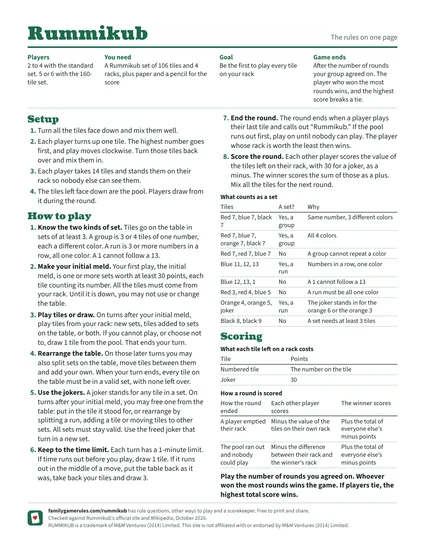
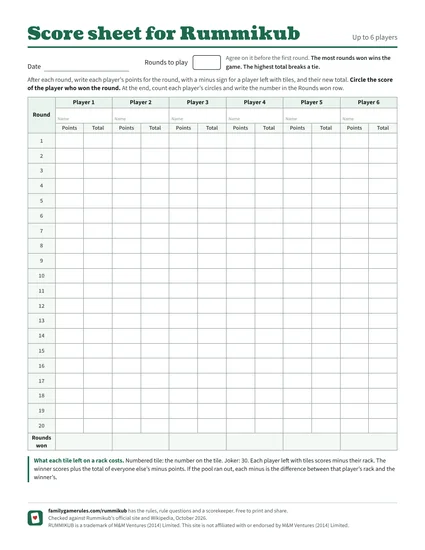
Print the whole game on one page, and a score sheet made for Rummikub. Both are free PDFs for Letter paper.
Setup
2 to 4 players with the standard 106-tile set, each playing alone. 5 or 6 can play with the larger 160-tile set, described further down.
You need: One standard Rummikub set: 106 tiles and 4 racks.
| In the set | Count | Worth when scoring |
|---|---|---|
| Blue tiles: two each of 1 to 13 | 26 | The number on the tile |
| Red tiles: two each of 1 to 13 | 26 | The number on the tile |
| Orange tiles: two each of 1 to 13 | 26 | The number on the tile |
| Black tiles: two each of 1 to 13 | 26 | The number on the tile |
| Jokers | 2 | 30 if left on your rack. In a set, the tile it stands for. |
| Total | 106 |
- Every numbered tile comes twice, so the set holds 8 tiles of each number.
- Each player also gets a rack, a stand that holds their tiles upright so only they can see them.
- The larger set for 5 or 6 players has 160 tiles: three of every numbered tile, 4 jokers and 6 racks.
- Turn all the tiles face down and mix them well.
- Each player turns up one tile. The highest number goes first, and play moves clockwise. Turn those tiles back over and mix them in.
- Each player takes 14 tiles and stands them on their rack so nobody else can see them.
- The tiles left face down are the pool. Players draw from it during the round.
| Players | Each player gets | Notes |
|---|---|---|
| 2 | 14 tiles | 78 tiles are left in the pool. |
| 3 | 14 tiles | 64 tiles are left in the pool. |
| 4 | 14 tiles | 50 tiles are left in the pool. |
| 5 or 6 | 14 tiles | Use the 160-tile set. 90 tiles are left in the pool with 5 players and 76 with 6. |
Each player’s rack
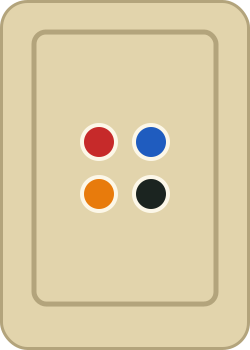
The pool
Every other tile, face down and mixed
- The official rules do not say what to do if two players tie for the highest tile, or if someone turns up a joker. Agree on a fix first, such as having those players turn up new tiles.
- Each new round starts the same way, with everyone turning up a tile to see who goes first.
How to play
Players take turns clockwise. On each turn you either play tiles from your rack or draw 1 tile. A round ends when someone empties their rack.
-
Know the two kinds of set
Tiles go on the table in sets of at least 3. A group is 3 or 4 tiles of one number, each a different color. A run is 3 or more numbers in a row, all one color. A 1 cannot follow a 13.
- A group can never repeat a color, so it stops at 4 tiles.
- A run has no top length. It can stretch as far as the numbers go, from 1 to 13.
A group
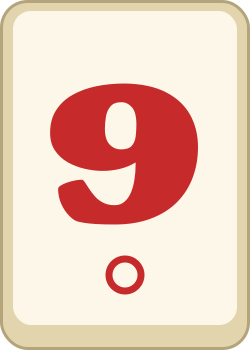
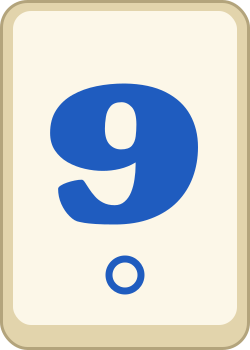
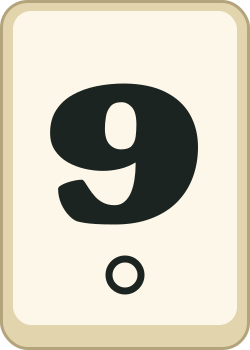
Same number, three colors. The orange 9 could be added.
A run
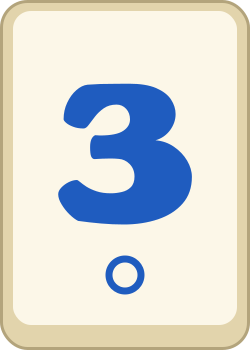
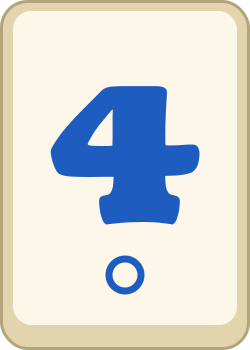
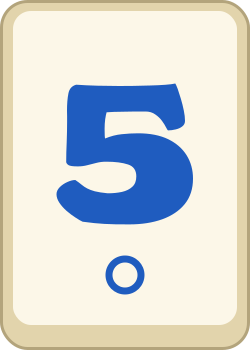
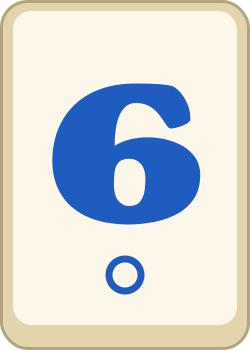
Numbers in a row, all blue
Not a group
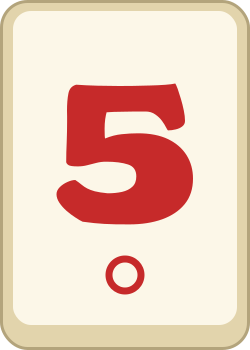
Red appears twice
Not a run
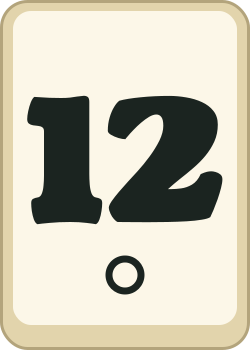
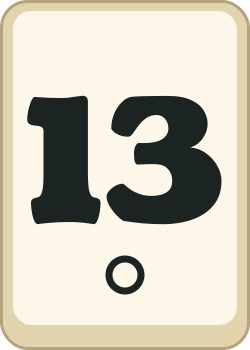
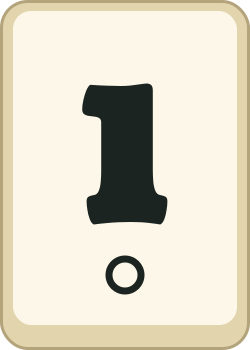
A 1 cannot follow a 13
Two sets that count, and two that do not. -
Make your initial meld
Your first play, the initial meld, is one or more sets worth at least 30 points, each tile counting its number. All the tiles must come from your rack. Until it is down, you may not use or change the table.
- A joker in your initial meld counts as the tile it stands for.
- Wait until your next turn before you add to other sets or rearrange the table. The initial meld turn is for your own new sets only.
- If you cannot reach 30 points yet, draw a tile and try again on a later turn.
Two sets: 24 + 9 = 33
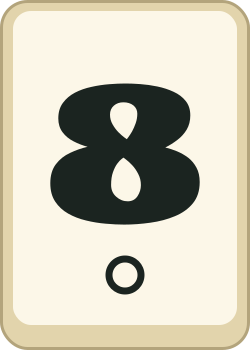
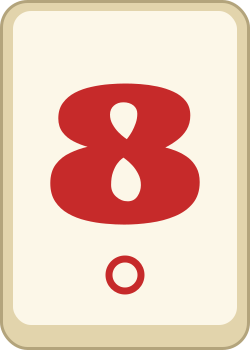
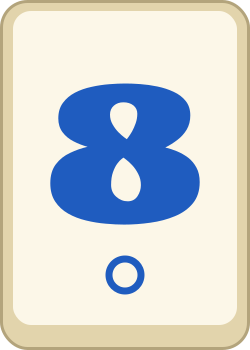
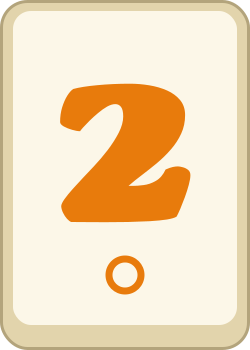
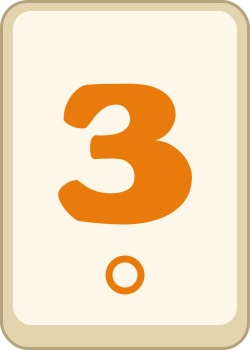
A group of 8s and a run of 2, 3, 4
With a joker: 11 + 12 + 13 = 36
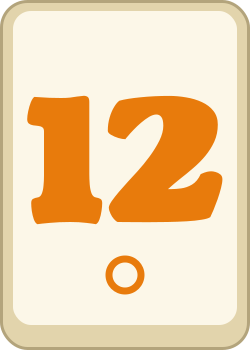
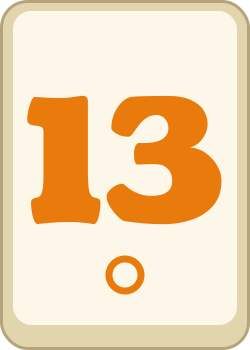
The joker counts as the orange 11
Two ways to make an initial meld of 30 or more. -
Play tiles or draw
On turns after your initial meld, play tiles from your rack: new sets, tiles added to sets on the table, or both. If you cannot play, or choose not to, draw 1 tile from the pool. That ends your turn.
- On any turn when you play, at least one tile must come from your rack. Moving tiles around the table on its own is not a turn.
- You never have to play. Holding tiles back is allowed, but you must then draw.
-
Rearrange the table
On those later turns you may also split sets on the table, move tiles between them and add your own. When your turn ends, every tile on the table must be in a valid set, with none left over.
- Add a tile to a set. A run takes the next number at either end. A group of 3 takes a tile of a missing color.
- Take a tile away from a set that still has 3 or more without it, such as the fourth tile of a group or the end tile of a run of 4, and use it in another set.
- Split a long run into two runs of at least 3 tiles each, adding a tile from your rack where one is needed.
- Tiles on the table stay on the table. They never go back to a rack, except under the time penalty below.
-
Use the jokers
A joker stands for any tile in a set. On turns after your initial meld, you may free one from the table: put in the tile it stood for, or rearrange by splitting a run, adding a tile or moving tiles to other sets. All sets must stay valid. Use the freed joker that turn in a new set.
- In a group of 3, the joker can be replaced by a tile of either missing color.
- The tiles you use to free it can come from your rack or from the table.
- On that turn you must also play at least one tile from your rack, as on any turn when you play.
- Nobody can take a joker from the table before making their initial meld.
- A joker still on your rack when the round ends costs you 30 points.
-
Keep to the time limit
Each turn has a 1-minute limit. If time runs out before you play, draw 1 tile. If it runs out in the middle of a move, put the table back as it was, take back your tiles and draw 3.
- Any watch or phone timer will do.
- Some rule versions allow 2 minutes a turn.
-
End the round
The round ends when a player plays their last tile and calls out “Rummikub.” If the pool runs out first, play on until nobody can play. The player whose rack is worth the least then wins.
- Once the pool is empty, a player who cannot play passes, since there is nothing left to draw.
- The rule sources we checked do not say who wins if two players tie for the lowest rack, so agree on it before you play.
-
Score the round
Each other player scores the value of the tiles left on their rack, with 30 for a joker, as a minus. The winner scores the sum of those as a plus. Mix all the tiles for the next round.
- If the pool ran out, each other player scores the difference between their rack and the winner’s rack, as a minus. The winner again scores the sum as a plus.
- A round’s scores always add up to zero, which is a quick way to check the sums.
| Tiles | A set? | Why |
|---|---|---|
| Red 7, blue 7, black 7 | Yes, a group | Same number, 3 different colors |
| Red 7, blue 7, orange 7, black 7 | Yes, a group | All 4 colors |
| Red 7, red 7, blue 7 | No | A group cannot repeat a color |
| Blue 11, 12, 13 | Yes, a run | Numbers in a row, one color |
| Blue 12, 13, 1 | No | A 1 cannot follow a 13 |
| Red 3, red 4, blue 5 | No | A run must be all one color |
| Orange 4, orange 5, joker | Yes, a run | The joker stands in for the orange 6 or the orange 3 |
| Black 8, black 9 | No | A set needs at least 3 tiles |
Example: splitting a run to fit a tile
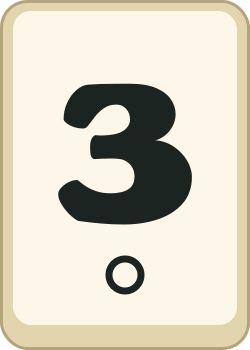
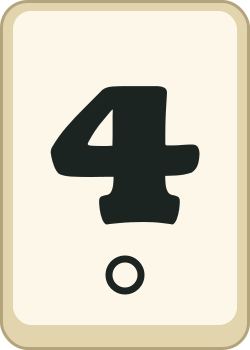
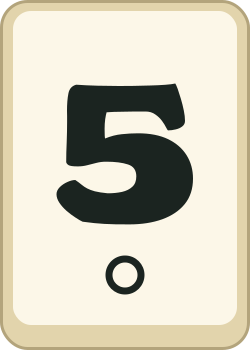
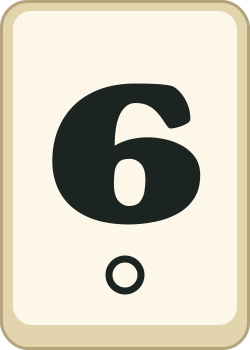
You made your initial meld on an earlier turn. The table holds a black run from 2 to 6. You hold a black 4 and a black 7. The 7 fits on the end of the run, but the 4 fits nowhere as the table stands. So you add the 7, making a run from 2 to 7, and split it after the 4. Your own 4 starts the second run. The table now shows black 2, 3, 4 and black 4, 5, 6, 7. Both runs have at least 3 tiles, so your turn is legal. Every numbered tile comes twice, so there really are two black 4s.
On the table before your turn
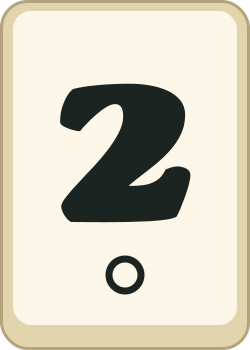
From your rack
First new run
All from the table
Second new run
Your 4 and 7 with the table’s 5 and 6
Scoring
Every player scores in every round. The winner gains points and everyone else loses them, so the round’s scores always add up to zero.
| Tile | Points |
|---|---|
| Numbered tile | The number on the tile |
| Joker | 30 |
| How the round ended | Each other player scores | The winner scores |
|---|---|---|
| A player emptied their rack | Minus the value of the tiles on their own rack | Plus the total of everyone else’s minus points |
| The pool ran out and nobody could play | Minus the difference between their rack and the winner’s rack | Plus the total of everyone else’s minus points |
- Only tiles still on a rack count. Tiles on the table are never scored.
- Before you start, agree how many rounds to play. The official rules count rounds in blocks of one round for each player, so 4 players play 4 rounds, or 8, or 12.
- The official rules invite groups to add their own house rules, and the length of the game is left to you.
Play the number of rounds you agreed on. Whoever won the most rounds wins the game. If players tie, the highest total score wins.
Write each player’s name at the top of a column. After each round, write every player’s points for the round, a minus for each player left with tiles and a plus for the winner, then update the running totals. If the pool ran out, each minus is the difference from the winner’s rack. Circle the winner’s score each round so you can count rounds won at the end.
A worked example: scoring one round
Four people are playing. You lay down your last tile and call out “Rummikub.” Ben, Cara and Dev still hold the tiles shown. Cara’s joker costs her 30. Each of them scores a minus, and you score their total as a plus: 69 points. The four scores add up to zero.
Ben
9 + 4 = 13
Cara
30 + 2 = 32
Dev
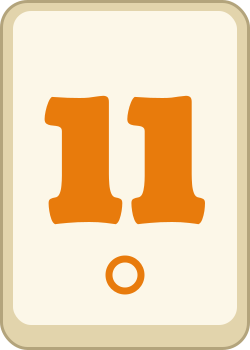
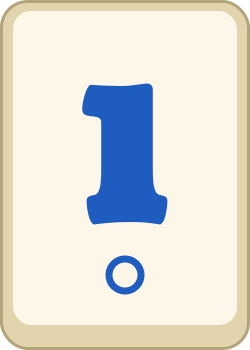
11 + 12 + 1 = 24
| What happened | Goes to | Points |
|---|---|---|
| Ben: red 9 | Ben | −9 |
| Ben: blue 4 | Ben | −4 |
| Cara: joker | Cara | −30 |
| Cara: black 2 | Cara | −2 |
| Dev: orange 11 | Dev | −11 |
| Dev: orange 12 | Dev | −12 |
| Dev: blue 1 | Dev | −1 |
| You: Ben’s 13 points | You | 13 |
| You: Cara’s 32 points | You | 32 |
| You: Dev’s 24 points | You | 24 |
| You | 69 | |
| Ben | −13 | |
| Cara | −32 | |
| Dev | −24 |
Scorekeeper
For 2 to 6 players. After each round, enter every player’s score: a minus for each player left with tiles, 30 for each joker, and the total of those as a plus for the winner. If the pool ran out, each minus is the difference between that player’s rack and the winner’s. The official rules leave the number of rounds to you, so it runs until you tap End the game. It counts the rounds each player wins, and the game goes to the most rounds won, with the highest total breaking a tie. It works in this browser, keeps the game if the page reloads, and needs no account.
Other ways to play
Rummikub for 5 or 6 players
The standard 106-tile set is for 2 to 4 players. For 5 or 6, use a larger set of 160 tiles. It has three of every numbered tile, from 1 to 13 in each of the 4 colors, plus 4 jokers and 6 racks. The official rules call it the XP set, and in the United States it is sold as a six-player edition. Everyone still takes 14 tiles, and the rest of the rules do not change. A block of rounds now runs to 5 or 6, one for each player.
House rules and other versions
- One set for the initial meld
- Some versions ask for the initial meld to be a single set worth at least 30 points, where the official rules allow one or more sets.
- Two minutes a turn
- Some versions give each player 2 minutes a turn in place of 1.
- Fewest tiles wins when the pool runs out
- When the pool is empty and nobody can play, the player with the fewest tiles on their rack wins the round. The official rules use the lowest value of tiles instead. Scoring is the normal way: each other player scores their rack’s value, 30 for a joker, as a minus, and the winner scores the sum as a plus.
- Draw two, with a river
- When you choose to draw, take 2 tiles. Keep one and add the other to the right end of a row called the river. To take a river tile, also pick up every tile added after it. Play the tile you wanted that turn, using rack tiles if needed. That ends your turn. The others go on your rack and cannot be used that turn.
- Playing cards in place of tiles
- The game can be played with two standard decks plus jokers. The ace counts 1, the jack 11, the queen 12 and the king 13. Each suit stands for one tile color.
- Highest total wins
- Keep a running total of each player’s round scores. When the game ends, the player with the highest total wins, however many rounds each player won.
Rule questions
How many tiles do you start with in Rummikub?
14 each. Every player takes 14 tiles face down from the mixed tiles and stands them on their rack. The rest stay face down in the middle as the pool. With 4 players that leaves 50 tiles in the pool.
How many points do you need for the initial meld?
At least 30. Each tile counts its number, and a joker counts as the tile it stands for. The 30 points can come from one set or several, but every tile must come from your own rack. You cannot use tiles already on the table.
Can you add to other sets on the same turn as your initial meld?
No. On the turn you make your initial meld, you play only your own new sets. Adding to sets on the table and rearranging them starts on your next turn.
Can you use a joker in your initial meld?
Yes. It counts as the tile it stands for. A joker used as the orange 11 in a run of orange 11, 12 and 13 is worth 11, so that run makes 36 points.
How do you take a joker from the table?
On your turn, put in the tile it stood for, or rearrange the table by splitting a run, adding a tile or moving tiles to other sets. When you finish, every set must be valid. Those tiles can come from your rack or the table. Use the joker that turn in a new set, and play at least one tile from your rack. You can do this only on turns after your initial meld.
Can you keep a joker you took from the table?
No. A joker taken from the table must go into a new set on that same turn. A joker you drew from the pool is different. You may keep that one on your rack, but it costs 30 points if the round ends while you still hold it.
Do you have to play if you can?
No. You may choose to draw a tile instead, even when you could play. Drawing ends your turn.
Can a run go from 13 back to 1?
No. The 1 is always the lowest number, so it can never follow a 13. Blue 12, 13 and 1 is not a run.
Is there a time limit in Rummikub?
Yes, 1 minute a turn under the official rules. If time runs out before you play, draw 1 tile. If it runs out in the middle of a move, put the table back as it was, take back your tiles and draw 3. Some versions allow 2 minutes.
What happens when the pool runs out?
Play goes on until nobody can play. The player whose rack is worth the least wins the round. Each other player scores the difference between their rack and the winner’s as a minus, and the winner scores the total as a plus. Some versions give the round to the player with the fewest tiles and score it as if that player had emptied their rack.
How much is a joker worth at the end of a round?
30 points against you if it is still on your rack. In a set on the table it is worth the tile it stands for, which matters for the initial meld.
How do you win a game of Rummikub?
Agree on a number of rounds before you start. The player who won the most rounds wins, and the highest total score breaks a tie. The official rules count rounds in blocks of one for each player, so 3 players play 3, 6 or 9 rounds.
Words used in Rummikub
- Tile
- One playing piece. Numbered tiles run from 1 to 13 in blue, red, orange and black.
- Rack
- The stand that holds your tiles upright so only you can see them.
- Pool
- The face-down tiles left after everyone has taken 14. You draw from it.
- Set
- Tiles played together on the table: a group or a run, at least 3 tiles.
- Group
- 3 or 4 tiles with the same number, each a different color.
- Run
- 3 or more tiles with numbers in a row, all the same color. The 1 cannot follow the 13.
- Initial meld
- Your first play: sets worth at least 30 points, all from your own rack.
- Joker
- A tile that can stand for any tile in a set. It costs 30 points if it is left on your rack.
- Manipulation
- The official name for rearranging sets on the table: splitting them, moving tiles and adding your own.
- Rummikub
- What you call out when you play the last tile from your rack.
- Round
- One deal of the tiles, played until a player empties their rack or nobody can play. The official rules call this a game and use round for a block of them.
What you need
- A Rummikub set106 tiles and 4 racks, for 2 to 4 players.Find it on Amazon (A Rummikub set, opens in a new tab)
- A six-player Rummikub setThe set you need for 5 or 6 players. It plays 2 to 6 and has 160 tiles, including 4 jokers, and 6 racks.Find it on Amazon (A six-player Rummikub set, opens in a new tab)
- A one-minute timerOptional. Any timer works for the 1-minute turn limit.Find it on Amazon (A one-minute timer, opens in a new tab)
- A score pad and pencilPlain paper works. Our printable score sheet has a column for each player.Find it on Amazon (A score pad and pencil, opens in a new tab)
As an Amazon Associate, we earn from qualifying purchases. How the site is paid for.
Checked against
These rules are written in our own words from Rummikub’s official site and checked against Wikipedia. Sources last checked on October 12, 2026.
- First source: Rummikub’s official site, Rummikub instruction sheet 2600 for the standard 106-tile set and Rummikub XP, by Lemada Light Industries for M&M Ventures (2014) Limited (sheet code D-2600-1236-0041, date code 120819). The tiles and racks, players and ages, choosing the first player, 14 tiles each, groups and runs, the 1 that cannot follow 13, the 30-point initial meld from your own rack, drawing 1 tile, the 1-minute limit and the 3-tile penalty, rearranging the table, the joker and its 30-point cost, the end of a round, both ways of scoring, games and rounds, the overall winner, and the 160-tile set for 5 or 6 players.
- Second source: Wikipedia, Rummikub. Checks the tiles, the deal, sets, the initial meld, jokers, the end of a round and scoring against the 1998 Pressman American edition its rules follow. Adds no building on the table on the initial meld turn, and the variants: a single set for the initial meld, 1 or 2 minutes a turn, fewest tiles when the pool runs out, drawing two with a river, and playing cards.
Other sources we used (2)
- Goliath Games, Rummikub product page (United States). Ages 8 and up on the US box, 2 to 4 players, 106 tiles, 4 racks and the 20 to 40 minute playing time.
- Goliath Games, Rummikub Six Player Edition product page (United States). Confirms the 160-tile set for 2 to 6 players: three sets of 1 to 13 in 4 colors, 4 jokers and 6 racks.
Where the sources differ (9)
| Topic | Rummikub’s official site | Wikipedia | This page |
|---|---|---|---|
| Winner when the pool runs out | The player with the lowest value of tiles on their rack. | The player with the lowest number of tiles on their rack. | Follows the official sheet. Fewest tiles is listed as a variant and in the rule questions. |
| Scoring when the pool runs out | Each player subtracts their rack total from the winner’s total, which gives a negative number, and the winner scores the sum of those as a plus. | The player with the fewest tiles wins, and scoring is then done the normal way: each other player’s rack total comes off their score and is added to the winner’s. | Reads the official sheet as the difference between each rack and the winner’s rack. That reading is in editorial. Wikipedia’s fewest-tiles rule, scored the normal way, is a variant. |
| How the whole game is won | A round is as many games as there are players, and the players choose how many rounds. The player who won the most games wins, and the highest score breaks a tie. | Keeps running scores from game to game and sets no number of games. The highest total wins. It also says that when the game ends, the points of a player who never made an initial meld go to each other player. | Follows the official sheet, using round for one deal. No target or fixed number of rounds is set. Wikipedia’s highest-total rule is a variant. Its rule for a player who never made an initial meld is left out, because it does not say which points it means. |
| Time limit | 1 minute per turn. Going over means drawing 1 tile. Failing to finish a move means restoring the table, taking back your tiles and drawing 3. | One or two minutes per turn. No penalties given. | 1 minute with the official penalties. 2 minutes is listed as a variant. |
| Initial meld of one set or several | One or more sets totalling at least 30 points. | A set, or sets in some versions, worth at least 30. | One or more sets. A single set is listed as a variant. |
| Playing on the table on the initial meld turn | Building onto other sets is described for the turns after the initial meld. | States outright that a player may not make the initial meld and play on other sets in the same turn. | Not on the same turn. Wikipedia states it, and the official wording points the same way. |
| Number of players | 2 to 4 with the 106-tile set. The 160-tile XP set is for 5 or 6. | 2 to 4. Mentions sets with four jokers without detail. | 2 to 4, with 5 or 6 on the larger set as a version. |
| Ages | 7 to adult. | Not stated. | 7 and up, with a note that Goliath’s US box says 8 and up. |
| Trademark owner | Names M&M Ventures (2014) Limited as the owner of the RUMMIKUB trademark. | Says the game was first made by Lemada Light Industries, and that in 2026 Longshore Limited acquired the worldwide rights, including the Rummikub trademark, to the physical tabletop game, excluding Israel, the United States, Canada and the online game. | The brand notice names the owner printed on the official sheet. |
What on this page is our own
- The playing time of 20 to 40 minutes a round is Goliath’s figure for the US box, given here as an estimate.
- The split-run example, the two initial meld examples, the sets table and the scoring example are our own, and so is their arithmetic.
- The pool sizes after the deal (78, 64, 50, 90 and 76 tiles) are our arithmetic. The official sheet gives 14 tiles each in its general setup and does not repeat it for the 160-tile set.
- The count of 26 tiles in each color and 8 of each number is our arithmetic from two of every tile in 4 colors.
- Reading the pool-runs-out scoring as the difference between each rack and the winner’s rack is our reading of the official sheet, which says each player subtracts their total from the winner’s total.
- Splitting the time penalty into a turn with no play (draw 1) and an unfinished move (draw 3, not 1 and 3) is our reading of the official sheet’s two separate rules.
- That at least one rack tile must be played on any turn when you play rests on the official joker rule, which says so for the joker turn and adds that this is as on any other turn.
- That tiles on the table never go back to a rack rests on Wikipedia, which says a tile taken from a set must be played that turn and “cannot be kept for later use”. The official sheet gives no way to do it apart from the time penalty.
- That a player who cannot play once the pool is empty passes is our reading. That a round’s scores add up to zero is our arithmetic from the official note that the winner’s score equals the other players’ total.
- The fix for a tie or a joker when drawing for first player comes from no source. The page says the official rules do not cover it.
- Neither source says who wins a tie for the lowest rack when the pool runs out. The page says so and leaves it to the players.
- Counting rounds in blocks, such as 3, 6 or 9 for 3 players and 4, 8 or 12 for 4 players, is our arithmetic from the official rule that a block has one round for each player.
- A block of 5 or 6 rounds for 5 or 6 players is our extension of the official sheet’s pattern, which gives blocks only for 2, 3 and 4 players and lets the players choose the number of rounds.
- Wikipedia says that to take a tile from the river you pick up all the tiles “preceding” it, and that the oldest tile you pick up must be played. Reading “preceding” as the tiles added after the one you want is ours. It is the only reading in which the tile you want is the one you must play.
- The advice on keeping score on paper, the timer note and the notes under What you need are ours. The score sheet and scorekeeper are our own design.
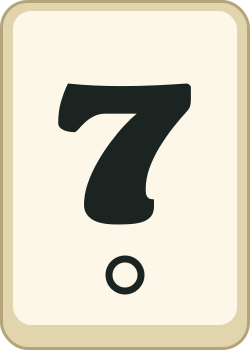
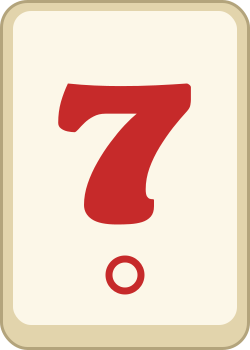
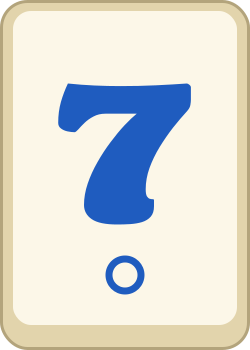
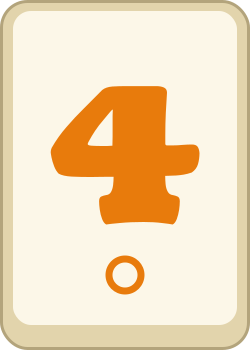
- The pieces pictured at the top of the page are our own example.
Spotted a mistake? Email [email protected] and we'll check it against the sources.