Mexican Train rules
Mexican Train is a dominoes game for a double-12 set and a big table of players. Each player builds their own train of tiles out from a center double, and one extra train, the Mexican train, is open to everyone. A double still uncovered when a turn ends must be covered next. After 13 rounds, the lowest score wins.
Also called Mexican Train Dominoes, Mexican Trains.
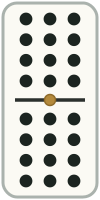
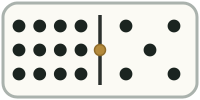
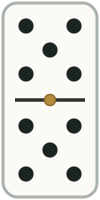
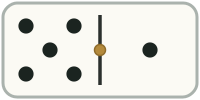
- Players
- 2 to 10, each playing alone
- You need
- A double-12 domino set (91 tiles), a marker for each player, and paper and a pencil. A hub for the center tile is handy but not needed.
- Deal
- 15 tiles each for 2 to 4 players, 12 for 5 or 6, 10 for 7 or 8, and 8 for 9 or 10
- Each turn
- Play 1 tile on your own train, the Mexican train or a train with a marker. If you cannot, draw 1.
- Goal
- Play all your tiles, or be left holding as few pips as you can
- Game ends
- After 13 rounds, one for each double from 12 down to blank. The lowest total wins.
- Playing time
- About 2 to 3 hours for all 13 rounds
Quick start
- Put the double-12 in the middle of the table. It is the engine. Shuffle the other tiles face down and draw 15 each for 2 to 4 players. The rest are the boneyard.
- Each player builds a train from the engine toward their seat. The first tile must match the engine. One more train, the Mexican train, is open to everyone.
- On your turn, play 1 tile on your own train, the Mexican train or any train with a marker. If you cannot, draw 1 and play it if it fits.
- If you still cannot play, put your marker on your train. Anyone may now play there. Take the marker off when you next play on your own train.
- After you play a double, play one more tile. If your turn ends with nothing on the double, it must be covered before anyone plays anywhere else.
- The round ends when someone plays their last tile or nobody can play. Everyone scores the pips left in hand. Play 13 rounds, from the double-12 engine down to the double-blank. Lowest total wins.
Rule sheet and score sheet
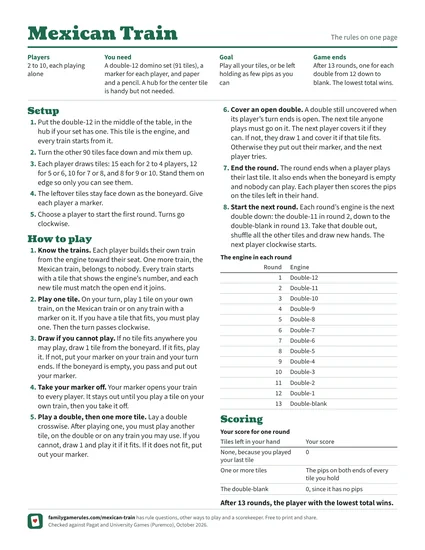
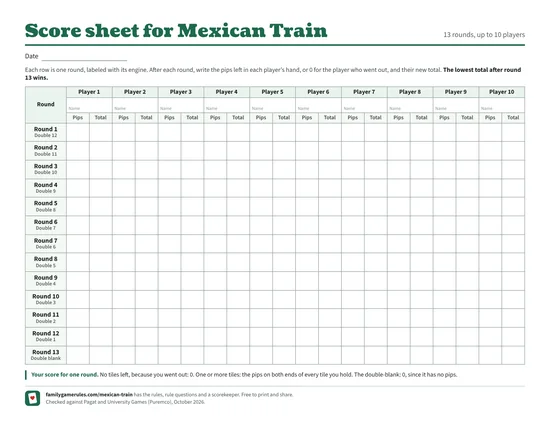
Print the whole game on one page, and a score sheet made for Mexican Train. Both are free PDFs for Letter paper.
Setup
2 to 10 players with one double-12 set. It is probably best with 4 or more. Everyone plays for themselves.
You need: One double-12 domino set of 91 tiles, plus a marker for each player.
| In the set | Count | Worth when scoring |
|---|---|---|
| Doubles, from the double-blank to the double-12 | 13 | The pips on both ends: 0 to 24 |
| Singles (two different numbers) | 78 | The pips on both ends: 1 to 23 |
| Total | 91 |
- Each end of a tile shows a number from 0 to 12 as dots, called pips. An end with no pips is a blank.
- Each player needs a marker to show when their train is open to everyone. Coins work. Some sets come with small train markers for this.
- Some sets also come with a hub, also called a station or centerpiece. It holds the center double and spaces the trains around it. Without one, lay the center double in the middle of the table.
- Put the double-12 in the middle of the table, in the hub if your set has one. This tile is the engine, and every train starts from it.
- Turn the other 90 tiles face down and mix them up.
- Each player draws tiles: 15 each for 2 to 4 players, 12 for 5 or 6, 10 for 7 or 8, and 8 for 9 or 10. Stand them on edge so only you can see them.
- The leftover tiles stay face down as the boneyard. Give each player a marker.
- Choose a player to start the first round. Turns go clockwise.
| Players | Each player gets | Notes |
|---|---|---|
| 2 to 4 | 15 tiles | 60 tiles are left in the boneyard with 2 players, 45 with 3 and 30 with 4. |
| 5 or 6 | 12 tiles | 30 tiles are left in the boneyard with 5 players and 18 with 6. |
| 7 or 8 | 10 tiles | 20 tiles are left in the boneyard with 7 players and 10 with 8. |
| 9 or 10 | 8 tiles | 18 tiles are left in the boneyard with 9 players and 10 with 10. |
The engine
In the hub, or in the middle of the table
Each player’s hand

Stood on edge, faces toward their owner
Boneyard
Face down, off to one side
- Mexican Train is played many ways, and the rule sheets packed with domino sets differ too. The hand sizes above are from the main rule source we checked. Agree on the rules before the first round, and check the variants further down.
- One set maker’s rule sheet prints other numbers. For a double-12 set it gives 18 tiles each for 4 players, 14 for 5, 12 for 6, 10 for 7 and 9 for 8. It does not use a double-12 set for 2 or 3 players.
- In some groups nobody sets the engine out. The player who drew the double-12 starts by laying it in the middle. That way of starting is listed under variants.
How to play
A game is 13 rounds. Each round has its own engine, starting with the double-12 and going down one double each round. The rules below are one round.
-
Know the trains
Each player builds their own train from the engine toward their seat. One more train, the Mexican train, belongs to nobody. Every train starts with a tile that shows the engine’s number, and each new tile must match the open end it joins.
- Your own train is private. Only you play on it, unless your marker is on it or a double on it needs covering.
- Any player may start the Mexican train on their turn, with a tile that shows the engine’s number. Lay it off to one side where everyone can reach it. There is only one Mexican train in a round.
- Some groups put a marker of its own on the Mexican train, such as a different coin, so nobody mistakes it for a player’s train.
-
Play one tile
On your turn, play 1 tile on your own train, on the Mexican train or on any train with a marker on it. If you have a tile that fits, you must play one. Then the turn passes clockwise.
- You choose which train to play on. You do not have to play on your own train first.
- You may not draw from the boneyard while you hold a tile that fits.
- On the first turn of a round, the starter can begin their own train or the Mexican train.
-
Draw if you cannot play
If no tile fits anywhere you may play, draw 1 tile from the boneyard. If it fits, play it. If not, put your marker on your train and your turn ends. If the boneyard is empty, you pass and put out your marker.
- If your train has not been started yet, put the marker where it would begin.
- The tile you draw can go on any train you are allowed to play on, not only your own.
- If your marker is already out, it stays there.
-
Take your marker off
Your marker opens your train to every player. It stays out until you play a tile on your own train, then you take it off.
- Other players adding tiles to your train does not remove your marker.
- Groups differ on when the marker comes off. Two other ways are listed under variants.
-
Play a double, then one more tile
Lay a double crosswise. After playing one, you must play another tile, on the double or on any train you may use. If you cannot, draw 1 and play it if it fits. If it does not fit, put out your marker.
- If your second tile is also a double, you must play a third tile, and so on. Your turn ends once you play a tile that is not a double, or put out your marker.
- A double can be your last tile. Play it and you are out. The round ends at once.
- Some groups lay doubles in line with the train instead of crosswise. It makes no difference to the play.
-
Cover an open double
A double still uncovered when its player’s turn ends is open. The next tile anyone plays must go on it. The next player covers it if they can. If not, they draw 1 and cover it if that tile fits. Otherwise they put out their marker, and the next player tries.
- The open double must be covered even when it sits on another player’s train that has no marker.
- Covering means playing a tile on the double that matches its number. The train then carries on from the far end of that tile.
- When more than one double is open, cover them in the order they were played.
- Once every double is covered, players may use any train they are allowed to play on again.
The engine
Mexican train, before
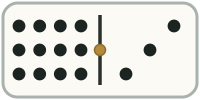
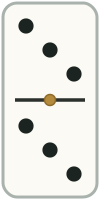
The double-three is open
Mexican train, after the 3-8 covers it
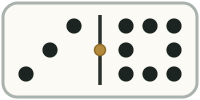
Open end: an 8
The double-three on the Mexican train was still uncovered when its player’s turn ended, so it is open. The next tile played anywhere must go on it. -
End the round
The round ends when a player plays their last tile. It also ends when the boneyard is empty and nobody can play. Each player then scores the pips on the tiles left in their hand.
- A player who went out scores 0 for the round.
- When you are down to 1 tile, warn the others. Tap the table or say so. Some sets come with a whistle or a sounding centerpiece for this. One set maker’s sheet leaves the penalty for forgetting to the players. It suggests deciding before play whether to let it go or set a penalty, such as drawing a tile, adding 50 points or skipping a turn. Another rule makes the player draw 2 tiles, if the boneyard has any.
-
Start the next round
Each round’s engine is the next double down: the double-11 in round 2, down to the double-blank in round 13. Take that double out, shuffle all the other tiles and draw new hands. The next player clockwise starts.
- Every train in the new round, the Mexican train too, must start with the new engine’s number.
| Round | Engine |
|---|---|
| 1 | Double-12 |
| 2 | Double-11 |
| 3 | Double-10 |
| 4 | Double-9 |
| 5 | Double-8 |
| 6 | Double-7 |
| 7 | Double-6 |
| 8 | Double-5 |
| 9 | Double-4 |
| 10 | Double-3 |
| 11 | Double-2 |
| 12 | Double-1 |
| 13 | Double-blank |
Example: you must cover the double first
It is round 1, so the engine is the double-12. Ben, on your right, played the double-three on the Mexican train. He had no tile to follow it, drew 1 that did not fit, and put his marker on his train. Now it is your turn, and the double-three is open. Your 9-4 fits the 9 at the end of your own train, but it must wait. Your 3-8 covers the double, so you play it there. That is your 1 tile, and your turn ends. With no 3 in your hand, you would draw 1 tile. If that did not cover the double, you would put out your marker.
The engine
Your train
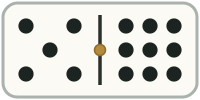
Open end: a 9
Mexican train
The double-three is open
Ben’s train
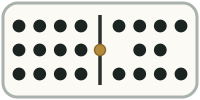
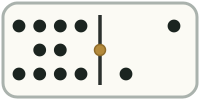
Ben’s marker is on it
Your hand
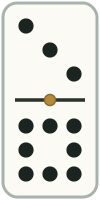
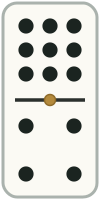
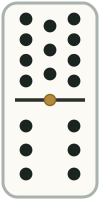
Only the 3-8 may be played now
Scoring
In Mexican Train, points count against you. At the end of each round, every player scores the pips left in their own hand, and the lowest total after 13 rounds wins.
| Tiles left in your hand | Your score |
|---|---|
| None, because you played your last tile | 0 |
| One or more tiles | The pips on both ends of every tile you hold |
| The double-blank | 0, since it has no pips |
- A tile counts the pips on both of its ends. The 12-11 counts 23, the double-6 counts 12 and the double-blank counts 0.
- Some groups give blanks a high value instead. That rule is listed under variants.
- Tiles left in the boneyard are not counted.
After 13 rounds, the player with the lowest total wins.
Use a sheet with a column for each player and a row for each round. Label each row with that round’s engine. After each round, write down each player’s pips and their new running total.
A worked example: scoring one round
Four players are in round 4, so the engine is the double-9. You play your last tile and go out. Ben still holds 2 tiles, Cara holds 2 and Dee holds 2. Each player adds up their own tiles. Dee’s double-blank adds nothing. You score 0, Dee 9, Cara 25 and Ben 26. These points go onto each player’s running total.
Ben’s hand
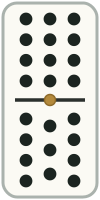
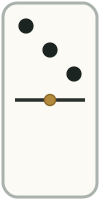
23 + 3 = 26 pips
Cara’s hand
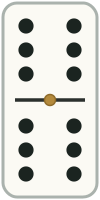
12 + 13 = 25 pips
Dee’s hand
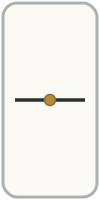
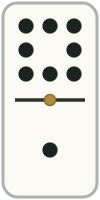
0 + 9 = 9 pips
| What happened | Goes to | Points |
|---|---|---|
| You went out | You | 0 |
| Ben’s 12-11 | Ben | 23 |
| Ben’s 3-blank | Ben | 3 |
| Cara’s double-6 | Cara | 12 |
| Cara’s 9-4 | Cara | 13 |
| Dee’s double-blank | Dee | 0 |
| Dee’s 8-1 | Dee | 9 |
| You | 0 | |
| Ben | 26 | |
| Cara | 25 | |
| Dee | 9 |
Scorekeeper
For 2 to 10 players over 13 rounds. After each round, enter the pips left in each player’s hand, and 0 for the player who went out. Each row shows that round’s engine. The lowest total after round 13 wins. It works in this browser, keeps the game if the page reloads, and needs no account.
Other ways to play
Mexican Train with a double-9 set
Mexican Train can also be played with a double-9 set of 55 tiles. The rules do not change. The first engine is the double-9, and each round goes down one double, so a full game is 10 rounds, ending with the double-blank. Each player draws 20 tiles with 2 players, 14 with 3, 11 with 4, 9 with 5 and 7 with 6. The rule sheet that gives these numbers does not use a double-9 set for 7 or 8 players.
House rules and other versions
- Build your train on the first turn
- Each player’s first turn of a round is special. You may lay as many tiles as you like on your own train, as long as each one matches. Nobody plays on any other train during first turns. A player who cannot start their train does not draw, and puts out their marker instead. Doubles left open are covered from the second turn on.
- The holder of the double starts
- Nobody sets the engine out before the draw. The player who drew the round’s double lays it in the middle and starts, and play goes clockwise. If nobody has it, everyone draws the same number of tiles from the boneyard until someone finds it.
- Wait a turn for the Mexican train
- The Mexican train cannot be started on anyone’s first turn. Any player may start it from their second turn on.
- Other times to take the marker off
- In one version your marker comes off as soon as any player adds a tile to your train. In another, it comes off whenever you play a tile anywhere.
- No marker when a double blocks you
- If a double is open and you cannot cover it, you still draw 1 as usual and cover it if that tile fits. If it does not fit, your turn ends but you do not put out your marker. The double, not your own train, is what stopped you.
- Limits on doubles
- Some groups allow only one double in a turn, so no more than one double is ever open. Others allow two, but only when you also hold a tile to play on one of them without drawing. The other double stays open for the next players.
- Other rules for open doubles
- In some versions nobody has to cover an open double. In others, open doubles are covered in the reverse of the order they were played. Another rule says a double need not be covered when every other tile with its number is already on the table.
- Costly blanks
- Each blank counts 25 points instead of 0, and the double-blank counts 50. This makes the double-blank the worst tile to be left holding.
- Plus points for the winner
- Only the winner of each round scores. That is the player who goes out, or the player with the fewest pips when nobody can play. They score the total of the pips left in all the other hands. If players tie for the fewest, they share those points. The highest total at the end wins.
- A shorter game
- Play fewer than 13 rounds, as agreed before you start.
Rule questions
How many dominoes do you start with in Mexican Train?
With a double-12 set, 15 tiles each for 2 to 4 players, 12 each for 5 or 6, 10 each for 7 or 8, and 8 each for 9 or 10. Set makers’ sheets differ. One gives 18 each for 4 players, 14 for 5, 12 for 6, 10 for 7 and 9 for 8, and does not use a double-12 set for 2 or 3. Settle the number before the first round.
What happens when you play a double?
Lay it crosswise, then play one more tile. That tile can cover the double or go on any other train you are allowed to use. If you have nothing to play, draw 1 tile and play it if you can. If you still cannot, put your marker on your train. If your turn ends with nothing on the double, it is open, and the next tile anyone plays must cover it.
What if the next player cannot cover a double?
They draw 1 tile. If it covers the double, they play it. If not, they put their marker on their own train and their turn ends. The next player must then try to cover it. This carries on around the table until someone covers it. Nobody may play anywhere else until then.
Do you have to cover a double on someone else’s train?
Yes. The double must be covered even if it sits on another player’s train that has no marker on it. It is the one time you may play on a private train that is not open.
Can you play two doubles in one turn?
Yes. After each double you play another tile, and that tile can be a double too. Your turn ends when you play a tile that is not a double, or put out your marker. Doubles left open are covered in the order they were played. Some groups allow only one double a turn, and some allow two only if you hold a tile to follow them.
Can you go out on a double?
Yes. If a double is your last tile, play it and you are out. Nobody has to cover it, because the round ends right away.
When do you take your marker off your train?
When you play a tile on your own train. Your train is then private again. Other players adding to your train does not take your marker off. Some groups remove it as soon as anyone plays on your train, and some when you play anywhere.
Can you play more than one tile on your first turn?
Not in the main rules here, where every turn is 1 tile, plus one more after a double. Another version says yes. On your first turn of each round you may lay as many matching tiles as you like on your own train. Nobody plays on the Mexican train or other trains until everyone has had a first turn. If someone goes out on that turn, the others still take their first turns.
What happens when the boneyard runs out?
Play goes on without drawing. A player who cannot play passes and puts out their marker. If nobody can play, the round ends and everyone counts the pips left in hand.
Is the double-blank worth 50 points in Mexican Train?
Not in the main rules. It has no pips, so it counts 0. Some groups score each blank as 25 points and the double-blank as 50. Agree on it before you start.
Do you have to say when you have one tile left?
Yes, under the rules on this page, though not every rule source asks for it. Tap the table, say so, or sound the whistle if your set has one. One set maker suggests deciding before play whether to let it go or set a penalty, such as drawing a tile, adding 50 points or skipping a turn. Another rule makes a player who forgets draw 2 tiles, if the boneyard has any.
What if two players tie for the lowest total?
The main rule sources we checked do not settle it. One rule gives the win to the tied player with the most rounds scored at 0. If they are still tied, the one with the lowest single round score above 0 wins.
Words used in Mexican Train
- Engine
- The double in the middle of the table that every train starts from. It is the double-12 in round 1 and one double lower each round after.
- Hub
- A stand that holds the engine and spaces the trains around it. Also called a station or centerpiece. It is optional.
- Train
- A line of tiles running out from the engine. Each player has one of their own.
- Mexican train
- The extra train that belongs to nobody. Any player may add to it on any turn.
- Marker
- A coin or small toy train put on your own train when you cannot play. While it is there, anyone may add to your train.
- Boneyard
- The face-down tiles left after everyone has drawn a hand. Players draw from it when they cannot play.
- Pip
- One dot on a tile. A tile counts the pips on both its ends.
- Double
- A tile with the same number on both ends, such as the double-12.
- Open double
- A double that still has no tile on it when the turn that played it ends. It must be covered before anyone plays elsewhere. Also called an unsatisfied double.
- Cover
- To play a tile on a double, matching its number. Also called satisfying or closing the double.
- Going out
- Playing your last tile, which ends the round. Also called dominoing.
What you need
- A double-12 domino set91 tiles. Some sets sold for Mexican Train come with a hub and train markers.Find it on Amazon (A double-12 domino set, opens in a new tab)
- Train markersOptional. Coins work as well, one for each player.Find it on Amazon (Train markers, opens in a new tab)
- Domino racksOptional. A rack holds your tiles upright so nobody else can see them.Find it on Amazon (Domino racks, opens in a new tab)
As an Amazon Associate, we earn from qualifying purchases. How the site is paid for.
Checked against
These rules are written in our own words from Pagat and checked against University Games (Puremco). Sources last checked on October 12, 2026.
- First source: Pagat, Mexican Train. The double-12 set, the hand sizes for 2 to 10 players, the boneyard, the 13 rounds from double-12 to double-blank, one tile a turn, drawing 1, markers and when they come off, covering doubles and who must cover them, going out on a double, the round’s end, pip scoring, and the listed variations.
- Second source: University Games (Puremco), Domino Game Rules, Mexican Train (rule sheet B010788, 05/16). The set maker’s rules: play with a double-9 or double-12 set, the tiles drawn for each set and number of players, the engine set in the centerpiece before the draw, the starter moving clockwise each round, one tile a turn from the start, the Mexican train on one side of the table, doubles laid sideways, the extra tile after a double, open doubles, two doubles in a turn, going out on a double, the round’s end, warning when one tile is left and the optional penalties, the next-lowest engine each round, and the lowest total winning.
Other sources we used (2)
- University Games, Puremco Mexican Train Dominoes (product page, item 54005). What a Mexican Train set holds: 91 double-12 tiles, a centerpiece, 8 train markers and a whistle.
- Wikipedia, Mexican Train. The names station and hub, the marker coming off when the owner plays on it, tapping when one tile is left and the 2-tile penalty, blanks at 25 and the double-blank at 50, the tie-break, fewer rounds, the last-tile-of-its-number rule for doubles, and 15 tiles each for 3 players as a check.
Where the sources differ (12)
| Topic | Pagat | University Games (Puremco) | This page |
|---|---|---|---|
| Where the engine comes from | The player who drew the double-12 lays it in the middle and starts. If nobody has it, players draw equally from the boneyard until it turns up. Laying the double out before the shuffle is offered as an option. | The highest double goes in the centerpiece before the tiles are shuffled and drawn. A chosen player starts. | Follows University Games, which Wikipedia’s main description and Pagat’s option agree with. Pagat’s main rule is a variant. |
| Who starts each later round | The holder of that round’s double. Under the option of laying it out first, players take turns. | The starter moves one seat clockwise each round. | The starter moves clockwise each round. |
| The first turn of a round | On their first turn each player may lay as many tiles as they like on their own train. Nobody plays on other trains, and a player who cannot start does not draw but puts out a marker. Playing one tile at a time from the start is listed as a variation. | One tile a turn from the start. The first player may start their own train or the Mexican train. | One tile a turn, as University Games, and as Wikipedia gives for its basic rules. Pagat’s first turn is a variant and a question. |
| When the Mexican train may be started | By any player from their second turn on. | On any turn. The first player may start it instead of their own train. | Any turn, following University Games. Pagat’s rule is a variant. |
| Hub and markers | No hub. A penny for each player, and a nickel on the Mexican train. Some players use locomotive markers. | A centerpiece holds the engine. Markers go only on players’ own trains. | A hub is optional. One marker for each player. Marking the Mexican train is mentioned as something some groups do. |
| Tiles drawn | 15 each for up to 4 players, 12 for 5 or 6, 10 for 7 or 8, 8 for 9 or 10. | A table by set and number of players. Double-9: 20 each for 2 players, 14 for 3, 11 for 4, 9 for 5 and 7 for 6, not used for 7 or 8. Double-12: not used for 2 or 3, 18 for 4, 14 for 5, 12 for 6, 10 for 7 and 9 for 8. | Pagat’s numbers in the main deal table. A setup note and a question also give University Games’ double-12 numbers, and the double-9 version uses its double-9 numbers. Wikipedia’s 15 each for 3 players under 1994 rules agrees with Pagat. |
| Taking the marker off | It comes off when the owner plays on their own train. Others playing on it leave it in place. | Not stated. | Follows Pagat, which Wikipedia agrees with. Pagat’s two other timings are a variant. |
| Laying doubles | Crosswise or in line, as players like. | Sideways, at right angles to the train. | Crosswise, with a note that laying them in line changes nothing. |
| More than one double in a turn | Allowed. Each double must be followed by another tile, and open doubles are covered in the order they were played. | Two doubles in a turn, only if a third tile can be played from the hand, without drawing, on one of them. | Follows Pagat. University Games’ limit and Pagat’s one-double variation are a variant and are in a question. |
| Warning at one tile | Not mentioned. | Required, by sounding the centerpiece. Its optional penalties paragraph says to agree in advance whether to forgive or penalize, and suggests making the player who broke a rule draw a tile, keep an already drawn tile, add 50 points to their score or skip the next turn. | Warn the others. University Games’ advice to decide before play whether to forgive or penalize is given, with three of its example penalties. Wikipedia’s penalty of drawing 2 tiles is given as another rule. |
| Value of the double-blank | No special value. Players score the spots left in hand. | No special value for Mexican Train. The same sheet’s Chickenfoot rules give the double-blank 50. | 0. Blanks at 25 and the double-blank at 50 are a variant, from Wikipedia. |
| Number of players | Hand sizes are given up to 10 players. Probably best for 4 or more. | The text says 2 or more. Its table of tiles drawn marks 2 and 3 players as not used with a double-12 set, and 7 and 8 players as not used with a double-9 set. The product page says 1 to 8. | 2 to 10, from Pagat’s hand-size table. The double-9 version is for 2 to 6, from University Games’ table. |
What on this page is our own
- The playing time of about 2 to 3 hours is our estimate.
- The play example, the covering diagram and the scoring example are our own.
- The boneyard sizes are our arithmetic: 90 tiles, after the engine is set out, less the tiles drawn.
- The counts of 13 doubles and 78 singles, and tile values of 0 to 24 and 1 to 23 pips, are our arithmetic from the make-up of the set.
- The 10 rounds and 55 tiles of a double-9 game are our arithmetic from the next-lowest-engine rule and the make-up of the set.
- That tiles left in the boneyard are not counted follows from both main sources scoring only the tiles in hand.
- The table of engines for each round is our arithmetic from the rule that each round uses the next double down.
- The note that tapping the table or saying so are ways to warn the others combines Wikipedia’s tap with the set maker’s warning rule.
- The notes under What you need describe products and are not rules.
- The pieces pictured at the top of the page are our own example.
- Under the plus-points variant, that only each round’s winner scores and that the highest total wins are our reading. Pagat gives how the points are scored but does not say who wins the game.
Spotted a mistake? Email [email protected] and we'll check it against the sources.